In view of the current financial situation, the 2026/2027 dual budget will be the first austerity budget - the first since the last major budget consolidation in 2009. One reason for this is that the federal government has passed numerous legal requirements in recent years that local authorities now have to meet. The federal government will only provide limited financial compensation.
The aim of the state capital is to align the revenue and expenditure side in such a way that an annual surplus of around 200 million euros is achieved again by the 2030/2031 double budget in order to be able to make important investments in the future. Together with the draft plan, the administration is also presenting the first stage of a budget protection concept in consultation with the municipal council in order to secure the city's financial capacity to act and to be able to adopt an approvable budget in December. As part of its review of the supplementary budget for 2025, the regional council made it clear that the debt development to date is not compatible with the legal requirements. Future budgets could no longer be approved without effective consolidation.
Lord Mayor Dr. Frank NopperWe do not want to and cannot carry out an abrupt emergency stop, but only a controlled braking that can be felt by everyone.
Video recording
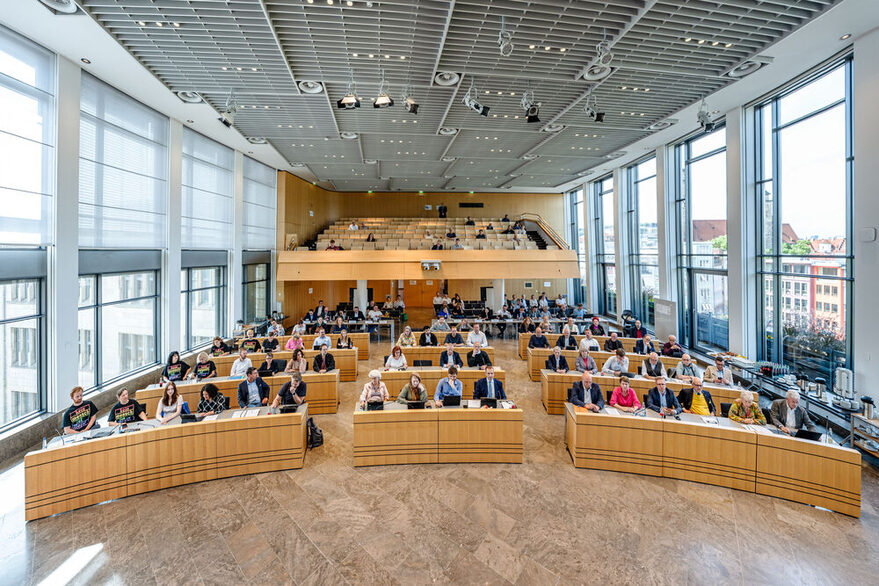
Lord Mayor Dr. Frank Nopper continues: "This controlled slowdown is - for reasons of intergenerational fairness - linked to the short and medium-term goal of keeping new debt as low as possible. It is linked to the medium-term goal of achieving annual surpluses again by the 2031 financial year. In other words: The 2026/2027 dual budget is an austerity budget, but it is an austerity budget with moderation and moderation."
Challenging budget consultations
The supplementary budget for 2025 still had a volume of EUR 5.87 billion. For 2026, the draft budget provides for a volume of EUR 5.26 billion, while the figure for 2027 is EUR 5.38 billion.
Despite the already planned improvements from the budget protection concept of around EUR 300 million and around EUR 330 million respectively, the current draft budget for 2026/2027 still shows worryingly high deficits: EUR -487.2 million for 2026 and EUR -303.8 million for 2027. Against this backdrop, the consultations on the double budget will be particularly difficult. In the past two years, it was still possible to offset deficits with surpluses from annual financial statements, but such free funds are no longer available.
Finance Mayor Thomas Fuhrmann makes it clear: "Even if the state capital of Stuttgart is currently still debt-free in its core budget, it can no longer rest on its laurels. In order for the plan for the next double budget to be submitted to the regional council for approval, the deficits for the next two years must not increase. In future, it will no longer be possible to make up any shortfalls in the budget with liquid funds, as the calculated free liquidity of the state capital Stuttgart will be below zero at the end of 2025. It is therefore imperative that the municipal council approves further improvements in earnings during the budget consultations."
Planned shortfalls from 2026 to 2030
According to current planning, the ordinary results in the budgets for the coming years are as follows
| 2026 | EUR -487.2 million |
| 2027 | EUR -303.8 million |
| 2028 | EUR -226.3 million |
| 2029 | EUR -284.8 million |
| 2030 | EUR -313.8 million |
In order for the draft budget to be approved, improvements in earnings of at least EUR 300 million for 2026 and EUR 330 million for 2027 are absolutely essential in the next two years. These are already included in the draft budget, but most of them still need to be backed up with specific measures.
Finance Mayor Fuhrmann explains: "The 2026 and 2027 budgets are structurally underfunded, as no sufficient cash surpluses can be generated to finance the new investments. The follow-up costs from projects, measures and job increases that have already been decided will also burden future budgets, which will further limit the financial scope of the state capital. As it will not be possible to generate sufficient funds in the income budgets to finance the necessary new investments, borrowing totaling EUR 2.4 billion has been budgeted to balance the financial budgets in the years 2026 to 2030. In order to prevent this billion-euro debt as far as possible, we must take countermeasures with the highest priority."
Reasons for the strained financial situation
Decline in trade tax
Rising expenditure on social benefits
Risks in the future reimbursement of refugee accommodation costs by the state
Fundamental problem: Connectedness
Against the backdrop of the dramatic financial situation of local authorities throughout Germany, the state capital Stuttgart commissioned an expert report in the summer to clarify the extent to which local authorities are entitled to financial compensation if they have to implement federal or state requirements. According to the report, local aut expert report in the summer to clarify the extent to which local authorities are entitled to financial compensation if they have to implement federal or state requirements. According to the report, local authorities must implement such requirements and, if necessary, postpone their own tasks, which may affect or violate the core of local self-government.
Necessary prioritization of investments
In view of the extremely tight budget situation, not all projects already approved by the municipal council can be implemented. In future, priority will be given to replacement and maintenance investments.
Mayor Nopper says: "In this difficult and tense situation, we should and must concentrate on the essentials. On maintaining, renovating and modernizing our municipal infrastructure and thus our schools, daycare centers, bridges, roads, paths and streets. On maintaining and improving the functionality of the administration, especially the functionality of the citizen-oriented areas of the administration. On the implementation of projects that have already been started, because stopping projects that have already been started would be associated with considerable economic disadvantages."
Care and maintenance of buildings, schools and roads
Targeted investments in organization and digital transformation
More cleanliness in the city center
Personnel planning with a focus on mandatory tasks
First Mayor Dr. Fabian Mayer explains: "In light of the budget situation, we have to focus on our mandatory and core tasks. There are currently around 1,500 vacancies in the area of a municipality's mandatory tasks. We will therefore continue to recruit, but will do so in relation to our core tasks. All jobs at the city are secure now and will remain so. We remain a reliable and attractive employer with a wide range of benefits."
New sources of revenue for budget consolidation
Overnight stay tax
Adjustment of charges for residents' parking
Dog tax
Growing burden due to mandatory tasks
As the federal and state governments are increasingly transferring new tasks to local authorities, often without sufficient funding, the scope for action is becoming narrower. As a result of this development, the state capital Stuttgart is also increasingly bound by statutory obligations, while voluntary services in areas such as culture, sport and social affairs can only be continued to a limited extent. The German Association of Cities and Local Authority Associations warn that local authorities have their backs to the wall if new obligations are not accompanied by financial resources. In order to secure its own ability to act, the state capital Stuttgart is relying on cross-departmental cooperation, prioritization and consistent budgetary discipline. In the future, Stuttgart will push even harder for reliable co-financing of new tasks vis-à-vis the state and federal government in connection with connectivity.
What's next?
The speeches for the general debate of the parliamentary groups on Thursday, November 6, from 3 p.m., and the opening speeches for the final third reading on Friday, December 19, from 8.30 a.m., in the main meeting room of Stuttgart City Hall will also be broadcast via livestream.
The double budget will be adopted on the evening of December 19 and published promptly on stuttgart.de.