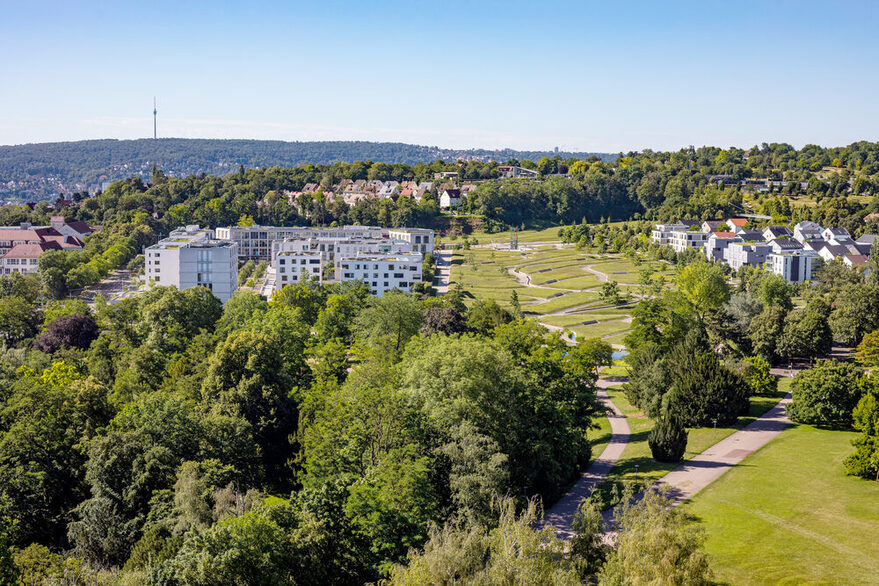
Urban greenery an indispensable infrastructure
Green roofs, new flower meadows, more trees: The state capital wants to sharpen and develop its profile as a green metropolis. The mission statement sees urban greenery as an indispensable infrastructure that is just as important as the technical and social infrastructure of any city.
To implement this green infrastructure, the municipal council launched a concept in 2018 that was accompanied by a significant increase in funding. Significantly more funding has been made available for the maintenance of existing parks, the ecological upgrading of green spaces, and new trees and shrubs. Likewise, urban gardening and the preservation of Stuttgart's vineyards will be promoted.
The Stuttgart model of a green metropolis is based on the "White Paper on Urban Greening" of the German Federal Ministry for the Environment, Nature Conservation, Building and Nuclear Safety. It defines the urban green as "indispensable infrastructure", which is decisive for the quality of life and the provision of public services.
Green network ensures well-being
Green corridors, forests and vineyards already characterize the urban area of Stuttgart. Over 50 percent of the area is forest, agriculture or recreation. The garden, cemetery and forestry office currently maintains around 1000 hectares of green space (excluding forests). In addition, 900 areas are maintained on behalf of other offices and municipal enterprises.
This diversity of nature contributes significantly to the quality of life and well-being. At the same time, it makes a valuable contribution to air pollution control. For this reason, the city of Stuttgart is investing more in the green infrastructure, for example, to plant new trees, create ecologically valuable flower meadows, better maintain parks and playgrounds, or further promote "urban gardening". In this way, a veritable "green network" is to be created that visibly permeates the urban area.
The motto is to preserve, develop and create. The state capital is making more money available for the diverse measures. For example, the city is funding the preservation of steep vineyards and dry stone walls with 850,000 euros per year from 2019 to 2022. A total of 914,000 euros will be spent on a species protection concept by 2022. Additional feasibility studies are to identify potential for new and better green structures.
Measures for more green in the city
The 2020/2021 double budget once again includes numerous medium and long-term measures for green spaces, parks and playgrounds:
- The city will increasingly maintain, redesign and develop seven parks of urban significance: including Villa Berg Park, Weißenburgpark, Stadtgarten, Karlshöhe, Uhlandshöhe, the park of the IGA 1993 and the Kurpark. For example, initial measures are to be implemented in the Villa Berg park. The total volume of the first three construction phases up to 2025 is 12.7 million euros. 1.955 million euros have been set aside in the double budget for the Weißenburgpark, Stadtgarten, Karlshöhe, Uhlandshöhe, IGA 1993 park and the Kurpark.
- The new construction of Diakonissenplatz is planned to cost a total of 1.75 million euros. EUR 1.4 million has been earmarked for this in the 2020/2021 dual budget and the remainder in the 2022/2023 dual budget. In 2020, EUR 102,000 will be provided for new seating in the Schloßplatz, Thouretstraße and Kirchstraße green spaces and the redesign of the Hasenberg neighbourhood square.
- In addition, the Goslarer Straße and Lindenbachsee green spaces in S-Weilimdorf and the Heidestraße viewing area in S-Feuerbach will be redesigned and upgraded to make them accessible to the disabled. 290,000 will be made available for this in the 2020/2021 double budget.
- The "New Green in the City" program, which has been in place since the 2016/2017 double budget, will be continued. The new edition provides for the ecological upgrading of existing green spaces and the creation of new green structures in urban areas. A total of 2 million euros will be made available in the dual budget for the creation of new green spaces.
- Over 5 million euros are available for the redesign, refurbishment and replacement of play equipment in Stuttgart's play areas. One focus is on the renovation of the forest playgrounds in Zuffenhausen, Kräherwald, Waldebene Ost, Dürrlewang and Bürgerwald.
- Funds totaling 2.2 million euros have also been approved until 2023 for the continuation of restoration measures and the conservation of the remaining historical tomb inventory at the Hoppel cemetery (2nd construction phase).
City green

