The basis for this is the action plan "Sustainably mobile in Stuttgart" in its version of July 18, 2017, submitted by the Lord Mayor and adopted by the City Council.
The action plan describes more than 100 individual measures in nine fields of action: including local public transport, motorized private transport, pedestrian and bicycle traffic, commercial transport, commuter traffic, the city's own mobility, mobility in the region, public relations work, and intermodality and networking. In the current 2018/2019 double budget, 25.6 million euros have been earmarked for this purpose.
The mobility package is supplemented by further measures from the "Alliance for Mobility and Air Pollution Control" of the municipal council amounting to 27.7 million euros.
Selection of measures for air pollution control and sustainable mobility
Job ticket for local public transport
The job ticket or company subscription initiated by the city is becoming increasingly successful: The number of employees in the VVS who use this subsidized ticket to travel to their workplace has risen from just under 84,000 to currently almost 90,000 over the course of 2019. Around 1,000 companies - including many smaller firms - now provide their employees with a subsidy for travel costs on local public transport.
At the City of Stuttgart and the Klinikum, almost 12,600 employees have a Jobticket - meaning that the number of users has more than doubled since its introduction. Around 60 percent of municipal employees now travel to work with the Jobticket. The municipal subsidy averages 28.30 euros per month and ticket user. Even large companies such as Porsche, Daimler or Allianz are on board with this subsidy model (company subscription) and thus support their employees in traveling to work in an environmentally friendly and congestion-free manner. The VVS also has a solution for small and medium-sized companies that cannot manage the minimum order quantity of 50 company subscriptions on their own. Either several companies can join forces or a smaller company "slips" under the umbrella of a larger company, so that a total of at least 50 tickets are ordered. The prerequisite for this is that the employers pay their employees a subsidy for the company subscription of at least 10 euros per month. In this case, not only the discount of 5 percent, but a discount of 10 percent compared to the regular annual ticket is granted.
Traffic flow and traffic control
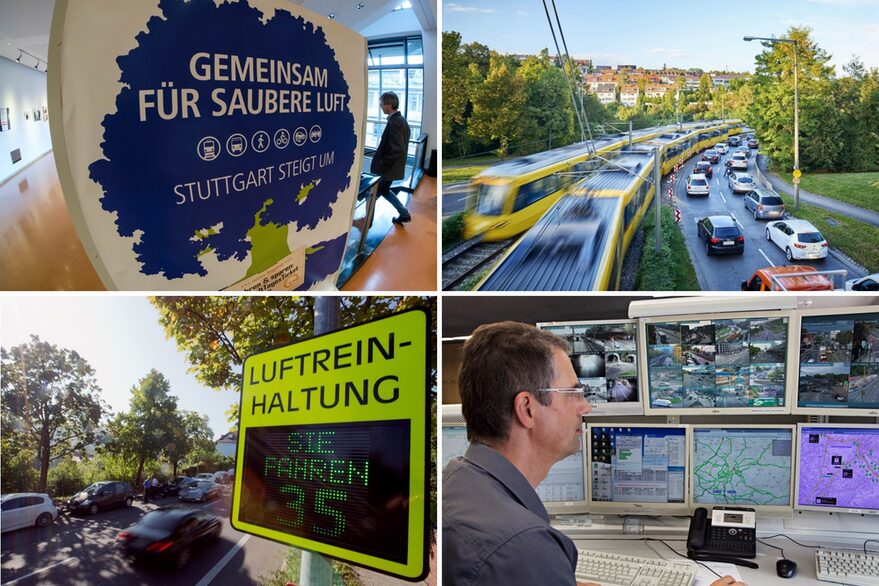
In order to avoid traffic jams or to resolve them more quickly, traffic within the state capital Stuttgart is controlled and directed by means of the Integrated Traffic Control Center (IVLZ). The IVLZ intervenes in the traffic via traffic lights, guidance systems and alternative route control depending on the situation and informs about traffic obstructions due to accidents, construction sites or high traffic volume with the help of 30 variable message boards at selected main roads as well as via traffic messages.
For the further development of the control center, the municipal council has made 3 million euros available in the current budget. Furthermore, measures for traffic control and guidance amounting to 9 million euros have been requested for the following years.
Numerous other measures are planned for the medium and long term to optimize traffic control and thus as a measure for air pollution control. The city intends to exploit the potential of digitalization in this context. For example, traffic control strategies are to be transmitted to navigation services with the aim of achieving city-friendly routing. An online calculation of current pollution levels in the Stuttgart valley basin is to be used for traffic control by integrating current vehicle data. Traffic lights are to be prepared for so-called Car2X communication with vehicles thanks to new special programs.
Expansion of pedestrian and bicycle traffic
The expansion of pedestrian and bicycle traffic plays an important role in the urban mobility concept. Thus, for the first time, a separate investment program for pedestrian traffic will be launched until 2022 at a cost of 3.4 million euros, which is intended to create a network of main pedestrian paths and strolling routes in Stuttgart's five inner-city districts. The concept is intended to promote pedestrian traffic in Stuttgart and strengthen it as an important mode of transport. In the valley basin, one third of all daily trips are made on foot.
In addition, the city continues to invest in the expansion of cycling. In the 2018/2019 double budget alone, an additional 7.6 million euros have been earmarked for the expansion of the main bike routes and other bike paths. This represents almost a doubling of the original cycling budget.
The city wants to increase the share of cycling to 25 percent in the long term. Based on a target resolution of the city council, Stuttgart is to become a "true bicycle city." This is accompanied by a significant increase in the bicycle budget in order to expand the main bicycle routes, set up bicycle lanes or install bicycle garages in residential areas. From 2020, around 20 euros and, in the long term, 40 euros per inhabitant per year are to be invested in cycling. This already includes, among other things, the promotion of cargo bikes for families and the expansion of the Regio-Rad fleet with cargo bikes.
Since May 2018, RegioRadStuttgart, a new regional and inter-municipal bicycle and pedelec rental system for Stuttgart, has been launched in the region. RegioRadStuttgart the ideal complement to public transport and thus a building block for a continuous sustainable travel chain. In Stuttgart, 600 bicycles, 100 pedelecs and 10 e-bikes are available. They can be rented and returned at around 75 stations throughout the city. At the same time, RegioRadStuttgart has started operations in Böblingen, Ditzingen, Freiberg am Neckar, Gerlingen, Kernen im Remstal, Leinfelden-Echterdingen, Leonberg, Ludwigsburg, Schwäbisch Gmünd and Urbach. Other municipalities will follow.
In-house mobility
The city is focusing on a systematic and complete conversion of the municipal vehicle fleet to low-emission or zero-emission mobility. To this end, the city is currently investing 300,000 euros per year. Currently, eight hybrid vehicles, 44 fully electric cars, 17 e-scooters and over 60 pedelecs are in use for the city. In addition, the garden, cemetery and forestry department is testing three electric cargo bikes and uses electric wheel loaders and electric watering vehicles. In addition, there are pilot projects with all-electric light trucks and all-electric sweepers.
Stadtwerke Stuttgart launched its e-scooter mobility service "stella-sharing" in 2016. In August 2016, stella was launched with 15 scooters, and the Stadtwerke has gradually increased the fleet to 75 (2017), 100 (2018) and now 200 (2019) vehicles. When it comes to procuring bicycles and pedelecs with a value of 1,000 euros or more, the city provides salary advances to its employees.
Electromobility
The state capital is a pioneer in promoting electromobility. For example, Stuttgart has around 400 public charging points, making it one of the densest networks of charging stations in Germany. In addition, more than 80 charging points outside of public spaces are accessible to everyone. They are located in parking garages or parking lots, at retailers, businesses or car dealerships.
The offer is growing: The city is driving forward the development of the charging network in a coordinated manner. For example, in the "Areal Eichstraße", which replaces the town hall garage, vehicles can be charged at 16 points and there will also be many new charging stations in NeckarPark. In spring 2019, the city council decided that up to 600 new normal charging points and up to 30 fast charging points can be realized in public spaces.
Since 2012, e-vehicles have already been allowed to park free of charge in all municipally managed areas. With the Electric Taxi Action Plan (ETAP), an important planning basis was created in 2017 to also convert the Stuttgart cab fleet to e-drives as quickly as possible with a subsidy program developed specifically for this purpose. In addition, the city administration is raising awareness among associations, guilds and dealers in Stuttgart for the introduction of e-mobility as well as the design of e-mobility in residential neighborhoods or larger residential properties of private companies/cooperatives. A funding program for "e-car sharing in the neighborhood" was approved by the city council in summer 2019.
City logistics
Among the most important questions for all cities are: How do goods, merchandise and products reach customers and how can delivery trips be avoided? Stuttgart has found numerous answers to these questions. For example, the city supports the LogSpaze project, in which goods are bundled at two points in the city (so-called microhubs) and brought to the stores using handcarts and cargo bikes, among other things. The use of electric vehicles ranging from bicycles to trucks is intended to make delivery traffic in the city center more environmentally friendly.
Another idea is for logistics companies to use free parking spaces in parking garages and then use cargo bikes for the last mile. To ensure that all projects are well networked, the city is working intensively with partners from business, science and associations.
Fine dust alarm
The state capital Stuttgart introduced the fine dust alarm in 2016 as an instrument for air pollution control.
In 2018 and 2019, the legal particulate matter limits were complied with at all measuring stations in the city area - i.e. also at Neckartor. In 2018, the Landesanstalt für Umwelt Baden-Württemberg (LUBW) recorded 20 exceedance days gravimetrically at the measuring station "Am Neckartor", in 2019 there were 27 exceedance days. Legally permissible are 35 exceedance days above 50 micrograms per cubic meter of air per year. In 2017, there were still 41 exceedance days (already deducted road salt and natural sources). The permissible annual average limits of 40 micrograms per cubic meter of air have already been reached at all stations since 2011.
Due to the compliance with the limit values two years in a row, the fine dust alarm has been discontinued in mid-April 2020. discontinued in mid-April 2020.
Neckartor street cleaning" test project
In consultation with DEKRA, the state capital Stuttgart terminates the "Neckartor street cleaning" project. The reason is to improve air pollution control. This is because the statutory particulate matter limits were complied with at all measuring stations in the Stuttgart city area in 2018 and 2019. Accordingly, the fine dust alarm was also discontinued in April of this year. In 2020, the Baden-Württemberg State Institute for the Environment has so far measured seven days of exceedance at the "Am Neckartor" measuring station (as of October 6).
In a first project phase, lanes as well as sidewalks around the measuring point "Am Neckartor" were cleaned in the state capital Stuttgart from March 1 to April 6, 2017, using a combination of water pressure cleaning and suction as well as mechanical cleaning from Sunday to Friday between 10 pm and 5 am. Evaluations at the time showed indications that this form of street cleaning could have a positive effect on particulate matter levels at Neckartor. At the end of July 2017, the City Council's Environment and Technology Committee therefore decided by a broad majority to continue the test project.
With the start of each new fine dust alert period in mid-October 2017 as well as 2018, the test project "Street Cleaning Fine Dust" was continued under the leadership of Dekra, as well as in the fine dust alert period 2019/2020.
Filter columns
In November 2018, 17 fine dust filter columns from the company MANN+HUMMEL were installed around the Neckartor. These were funded by the Baden-Württemberg Ministry of Transport and supported by the state capital Stuttgart.
In July 2019, the 17 fine dust filter columns were replaced by 23 further developed combi-filter columns. Following positive results in reducing fine dust pollution, the company had retrofitted the previous units with newly developed combi-filters. These are now said to be able to filter not only particulate matter (PM10) but also nitrogen dioxide (NO2) from the air.
The filter columns are 3.60 meters tall and each consist of three assembled components, the cubes. Equipped with filters and energy-efficient fans, they are capable of drawing pollutants from the ambient air they attract. A control unit allows the operation of the filter columns to be adjusted as needed, thus responding to the current air quality. Integrated sensors record air and weather data, which are compiled and analyzed in a cloud.
In the draft of the 4th update of the Clean Air Plan, the installation of additional filter columns on Hohenheimer Strasse and Pragstrasse was included as a new measure. The state government is financing the installation and operation of these filter columns in cooperation with the company: 23 combi-filters at Neckartor, 20 combi-filters at Hohenheimer Strasse and 10 combi-filters at Pragstrasse.
Environmentally friendly concrete slabs and road surfaces
Currently (September 2019), slab paving with titanium dioxide is being used in several construction projects to redesign the street space. The concrete slabs have been used at Kronprinzplatz in the city center as well as in the area of Furtbachstraße in the south of Stuttgart and in the area of Dorotheenquartier. Although it has been researched in principle that the titanium dioxide slabs break down nitrogen oxides, effects must be verified at the specific site of application. Pre-existing pollution and climatic conditions play an important role here.
At Neckartor, the state capital Stuttgart renewed the roadways with a photocatalytic road surface in April 2019, in the section between Willy-Brandt-Strasse and Cannstatter Strasse. A Clean Air (ClAir) asphalt was installed by STRABAG AG across the entire width of the roadway. The pavement has a special surface layer and is intended to help reduce air pollution caused by nitrogen oxides.
Test project moss wall
For the pilot study moss wall, an approx. 100 meter long and 3 meter high moss wall was erected along Cannstatter Straße in Stuttgart in spring 2017. At the end of April 2018, the moss mats were removed from the supporting structure in order to carry out comparative measurements without mosses at the same location. Complete removal of the moss wall took place at the end of June 2018.
The study was conducted by the Office of Environmental Protection of the State Capital Stuttgart in cooperation with the Institute of Structural Engineering and Design (design and planning of the moss wall), the Institute of Combustion and Power Plant Technology (air pollutant measurements) of the University of Stuttgart, and the State Museum of Natural History Stuttgart (biological investigations).
For the implementation of the project trial, which is scheduled to last two years, the municipal council has provided funds amounting to 388,000 euros. In addition, the Baden-Württemberg Ministry of Transport funded the study with 170,233 euros.
The background to the trial is scientific laboratory studies showing that mosses can remove particulate matter from the atmosphere and thus potentially help reduce particulate pollution in heavily polluted urban areas. What is special about mosses is that they not only filter particulate matter on plant surfaces like other plant species, but they also metabolize particulate matter and incorporate it into the plant skeleton, thus permanently binding the particulate matter. However, prior to the start of the experiment, there was a lack of evidence of the effect of mosses under real atmospheric conditions, but this was demonstrated in the pilot study.
The pilot study indicates that mosses can reduce particulate matter pollution, but a quantitative statement is not possible - the observed effect is in the order of magnitude of deviations due to measurement uncertainties.
Green infrastructure
In 2018/2019, the city will invest an additional eleven million euros in "green infrastructure": new trees will be planted, but also parks and playgrounds will be better maintained and "urban gardening" will be further promoted. As part of the continuation of the "1000 Trees Program," new tree locations will be created in streets and missing trees will be replanted in existing locations.
In addition, as part of the green infrastructure, implementation of the city's biodiversity concept has begun. Two construction supervisors were hired at the Garden, Cemetery and Forestry Department and, since winter 2018/19, so-called Top-E areas have been ecologically enhanced. These are areas where the greatest possible effect can be achieved with relatively little effort (efficiency areas). This is to be expanded in the future. Further information is available at www.stuttgart.de/artenschutzkonzept.
This is based on the understanding that green corridors, forests or vineyards shape the city and contribute significantly to the quality of life, but also to air pollution control.
Heating exchange program
With the aim of further reducing greenhouse gas emissions in the state capital of Stuttgart, the municipal council decided on October 17, 2019 to make changes to the funding guidelines for replacing coal stoves or oil-fired boiler systems in residential and non-residential buildings.
Around 15 percent of households in Stuttgart still heat with oil. To counteract this, the replacement of oil-fired boiler systems or coal-fired furnaces has been subsidized since 2018 under the motto "Make your heating system climate-friendly".
By replacing oil and coal with the more emission-friendly energy sources of environmental and district heating, gas and wood pellets (the latter outside the city center and Bad Cannstatt), the aim is to reduce particulate matter and CO2 emissions.