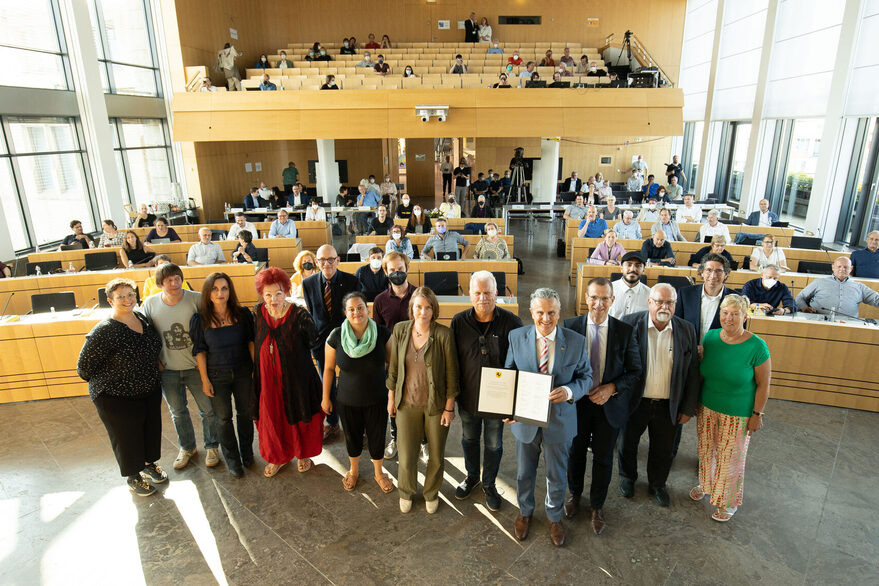
A "climate pact" seals the commitment - Lord Mayor Dr. Frank Nopper and representatives of the parliamentary groups and the Youth Council signed this "climate pact".
Lord Mayor Dr. Frank Nopper: "We want to take a giant step forward in terms of climate neutrality. Our new goal is very ambitious, it requires more than just unity in the council. It requires that we win over the entire city society and our business community. This will only work if we convince rather than polarize." He added that one has an overall responsibility for climate and environmental protection and for a thriving economy with secure jobs. Nopper continued, "The city's capacity for many tasks, especially climate and environmental protection, depends on the performance of our economy."
Climate protection should not only be well thought of and well-intentioned, climate protection must above all be well done and concretely implemented. Nopper named "the city administration, the municipal enterprises and associated companies, but also the business community and the skilled trades. Therefore we want to inspire together with the organizations of the handicraft in city and country more specialists for the climatic protection-relevant handicraft occupations. The climate protection-relevant skilled trades have enormous potential for local value creation; moreover, they ensure energy security and, as we must painfully experience in times of war in Ukraine, also energy independence for our country." The necessary investments are "investments for a good future of our city. Climate protection is a major joint municipal task of the city, the economy and urban society: Stuttgart can, should and must make a contribution to climate protection. In this sense, let us take action for more climate protection and for significantly more speed in terms of climate neutrality, not against the urban society, but with combined forces together with business and urban society," Nopper concluded.
Study on "Net Zero Stuttgart" as a basis
On the way to climate neutrality, CO2 emissions in 2030 are to be 80 % below the 1990 level. The corresponding reduction path will be aligned with the targets for energy savings and the expansion of renewable shares of final energy consumption. Immediately after the summer break, the administration will make a proposal on how the CO2 balance can be presented transparently in climate-relevant decisions of the municipal council. To this end, CO2 emissions are to be determined in a suitable manner and identified as "impact on climate protection" in draft resolutions.
The basis for achieving climate neutrality is the "Net Zero Stuttgart" study, which the state capital prepared together with the management consultancy McKinsey & Company. The study calls for the implementation of 13 packages of measures in the areas of electricity, heat, mobility, and waste and agriculture. The electricity sector is the most important sector, accounting for 47 percent of greenhouse gas emissions, followed by the heating sector with 37 percent and transportation with 14 percent.
Photovoltaics, heating technology and mobility
Measures with the greatest impact in the electricity sector include the expansion of photovoltaics on Stuttgart's rooftops and the Stadtwerke's investment in other renewable energies. In the heating sector, building renovation and the expansion of renewable heating technologies, such as heat pumps, are of great importance. In the mobility sector, the focus is on strengthening cycling and public transport and switching to low-emission drive systems.
According to the study, the investments of just under 11 billion euros required in the overall urban society pay off, as they are more than offset by savings. Depending on the level of the nationwide CO2 price, the investments will pay off in the 2030s or 2040s.
Extreme weather will increase
The study also shows that Stuttgart will have to prepare for significantly more extreme weather events in the future. In 2050, up to 50% more rainy winters and significantly more heavy rain events are expected, as well as more than twice as many heat days with temperatures above 30° Celsius. Stuttgart can prepare for this by implementing ten packages of measures. These include heat-reflecting construction and greening measures as well as the creation of sufficient drainage possibilities in the event of heavy rain and, in perspective, preparation for forest fires.
The draft resolution can be found here (opens in a new tab).