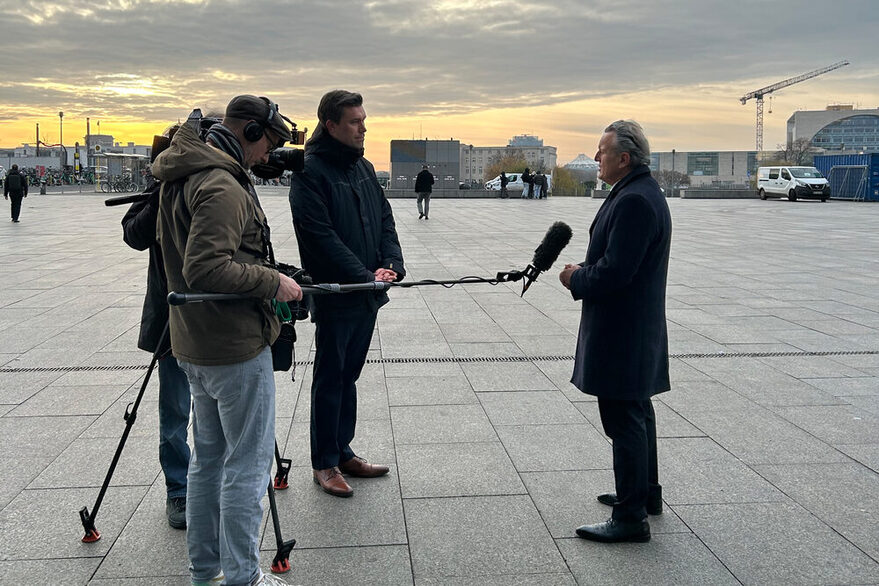
As a representative of the state capitals, Stuttgart's Lord Mayor Dr. Frank Nopper attended a lunch at the Chancellery today. There, Federal Chancellor Friedrich Merz received the presidents and chief executives of the municipal umbrella organizations for an exchange of ideas. Mayor Nopper had been invited to this meeting because he had initiated the fire letter from the German state capitals, which reached the Chancellery at the end of October. In it, the local authorities demanded that the federal government provide them with more financial support when they carry out tasks required by federal law.
Lord Mayor Dr. Frank NopperIt was a good conversation at eye level. The Federal Chancellor has clearly fully understood the seriousness of the local authority finance situation.
Nopper continued: "Unfortunately, he did not write any cheques for the municipalities. He appealed for us to join forces as quickly as possible to push ahead with a reform of the welfare state and modernization of the state. Only then could we talk about an appropriate distribution of expenditure between the federal, state and local authorities."
In his reply letter to the mayors of the German state capitals at the end of November, Chancellor Merz stated that the financial ability of the municipalities to act was an important concern for the federal government. However, the federal government had already sent out strong signals to ease the burden on local authorities with the special fund for infrastructure and climate neutrality as well as by taking on the municipal tax shortfalls identified in the law for a tax investment program. The federal government is currently engaged in a dialog with the federal states on how to achieve appropriate compensation if state and local authority expenditure increases as a result of federal legislation.
"Whoever orders must pay."
The mayors of the German state capitals formulated their expectations very clearly in their letter to the Chancellor on October 28: "Whoever orders must pay." For the year 2024, the municipalities are reporting a record deficit of 24.8 billion euros - the highest municipal financing deficit since 1990. For the year 2025, the municipalities are expecting a deficit of over 30 billion euros. The Association of Cities and Towns recently warned that local authorities need emergency financial aid to prevent them from falling into emergency budget law across the board.
Based on the current figures, the state capital Stuttgart must assume that the next double budget for 2026/2027 will not be approved. Part of the shortfall is also due to the fact that the federal government does not sufficiently compensate for some financial benefits, such as expenses for integration assistance in accordance with the Federal Participation Act. In 2020, the city of Stuttgart already had to spend 128 million euros on this, four years later - in 2024 - it was already 175 million euros. The city was only reimbursed a small amount in each case. The picture is similar when it comes to financing the operating costs of hospitals and local public transport.
This afternoon, Chancellor Merz will meet with the Minister Presidents in the Federal Chancellery. State modernization and municipal finances are on the agenda. Like the other members of the municipal umbrella organizations, the state capital Stuttgart will be following with great interest whether concrete proposals for resolutions are made there that could relieve the financial burden on the municipalities.