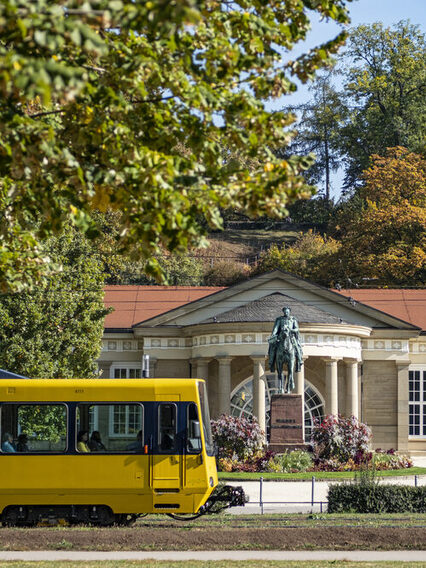
At today's public meeting of the municipal council committee, Lord Mayor Dr. Frank Nopper and the policy department provided information on the updated expansion plans of Stuttgarter Straßenbahnen AG (SSB). Although the measures have to be modified due to the current financial framework conditions, the expansion of public transport is to be continued - albeit at an adjusted pace.
Lord Mayor Dr. Frank Nopper"Unfortunately, we now also have to put the brakes on public transport costs. However, due to the difficult budget situation, we are proposing to spend less on public transport than previously planned. This very moderate and very moderate cost reduction compared to other major cities shows how important we consider public transport to be."
SSB is facing a significant increase in expenditure in the coming years. The reasons for this include collectively agreed reductions in working hours, increasing investments in infrastructure and vehicles as well as the expansion of services and higher costs in the area of climate protection. Without dynamically growing revenues from the federal and state governments, the city expects SSB's annual deficit to rise to over 200 million euros.
The Lord Mayor, who is also Deputy President of the German Association of Cities, is therefore calling on the federal and state governments to fulfill their financial responsibilities: They currently determine around 80 percent of SSB's income - mainly as a result of the introduction of the Deutschlandticket. If there is no adequate funding, there is a threat of substantial restrictions to the current public transport services.
Expansion continues - with targeted measures
Despite the tense situation, important expansion projects are to be implemented as planned. From next year, for example, the U1 light rail line (Fellbach - Heslach) will be operated with 80-meter trains, which will double the space available on this central line.
Further measures to be implemented:
- Construction of a new light rail depot in Weilimdorf
- Extension of the U13 line to Hausen
- Extension of the U19 line (extension to the Mercedes plant and increased frequency)
- More frequent trips on bus route 65 to the airport after the new station opens
- Increasing the frequency of the busy bus line 42 to every 5 minutes during rush hour
- Prioritization instead of deletion: projects on stand-by
In order to ease the structural burden on the budget, the city administration and SSB are proposing to forgo the binding implementation of some planned projects for the time being. The aim is to relieve the SSB's business plan by 25 million euros a year. The measures that will be postponed for the time being include
- Extended 10-minute light rail service in the evening
- Introduction of a night service on the light rail
- Improvements to the U8 line in the Filder region
These projects will continue to be planned so that they can be implemented quickly when the financial situation improves. In total, around 100 million euros can be saved over a period of five years.
Federal and state governments called upon - consequences of inaction
The introduction of the Deutschlandticket has fundamentally changed the revenue model for transport companies. While transport companies used to be able to decide on fares together with the public transport authorities in the Stuttgart Transport Association (VVS), the federal and state governments now influence SSB's income via the Deutschlandticket.
If it is not possible to secure long-term and adequate funding for local public transport, reductions in services could also become unavoidable in Stuttgart. Cities such as Heidelberg, Karlsruhe and Tübingen are already discussing or have already implemented cuts in local transport services.