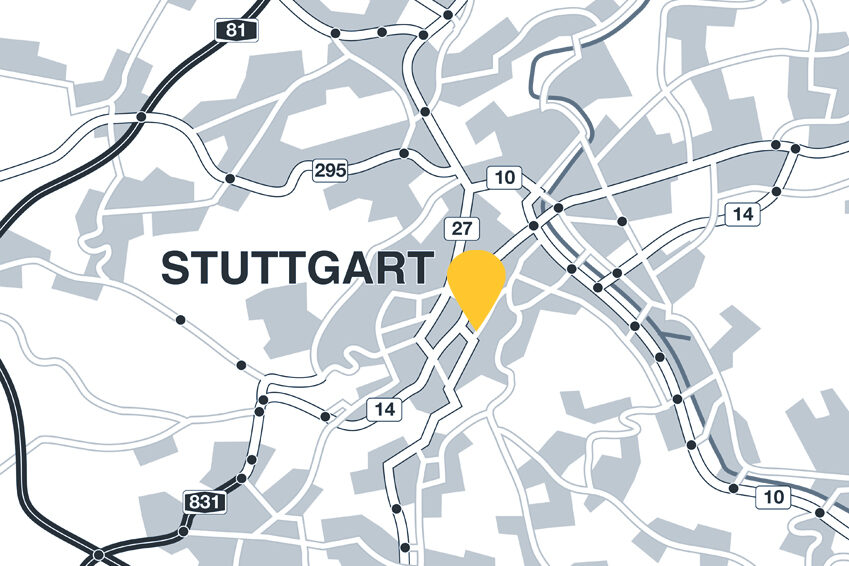
For thousands of years, maps have served to visualize spatial knowledge for the viewer in a clear and informative way. The basis for this is formed by data surveys and statistics with a spatial reference. For Stuttgart, the Statistical Office collects and determines extensive data and facts on a wide variety of topics - and thus provides a multi-layered overall picture for the city area and the city districts.
The range of thematic maps and diagrams facilitates access to the city administration's treasure trove of data and makes it easy to compare city districts or neighborhoods with one another. The development of indicators and spatial units over time can also be mapped concisely.
Statistics in cards
Small-scale structure of the Stuttgart urban area
Statistics have a temporal, thematic and spatial reference. The assignment of thematic content to a spatial unit is carried out using the system of small-scale classification, which is maintained and documented by the Statistical Office. Here, the urban area is hierarchically divided into city districts, city neighborhoods, city quarters, building blocks and building block sides. Other sub-areas of the city area for which statistics are kept available are, for example, school districts, electoral districts or traffic districts.
An overview of the small-scale division of Stuttgart is provided by the city district overview. In the city map of the City Surveyor's Office, a wide variety of subdivision units and district types can also be visualized.
Mr. Catterwell
