The "Hotel Silber" is a testimony to our history. Until April 1945, it was home to the Gestapo headquarters for Württemberg and Hohenzollern, where the National Socialists imprisoned, tortured and murdered thousands of people. The "Hotel Silber" was converted into a museum and place of learning in 2018 on the initiative of a community group. The permanent exhibition in the (opens in a new tab) "Hotel Silber" is dedicated to the perpetrators and their victims, the institution of the police and its role in three political systems in the 20th century.
The Stauffenberg Memorial is a permanent exhibition in the archive building of the Old Palace (opens in a new tab). It is dedicated to the resistance fighters and Hitler assassins Berthold and Claus Schenk Graf von Stauffenberg. Opposite, directly in front of the Stauffenberg memorial, is the memorial to the victims of National Socialism in Stuttgart, which was designed in 1970 by the German sculptor Elmar Daucher. The four massive black granite blocks are intended to express how difficult the period of tyranny was for the victims of National Socialism.
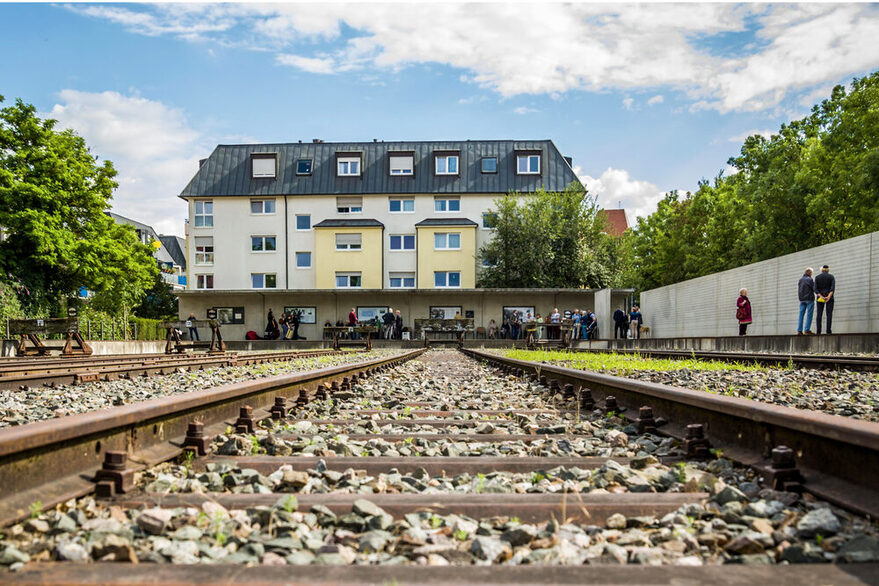
The Killesberg Memorial and the "Sign of Remembrance" memorial comm emorate the deportation of over 2,000 Jews and Sinti and Roma from Stuttgart and south-west Germany by the Gestapo in 1941 and 1942. The assembly point before the deportations was on the Killesberg, where today a steel ring in the ground commemorates the systematic murder of the people. Trains departed from Stuttgart Nordbahnhof for the Auschwitz extermination camp and the Riga, Theresienstadt and Izbica ghettos. Today, five historic tracks are silent witnesses to history. The "Sign of Remembrance" memorial (opens in a new tab) was created here.
The victims of National Socialism are also commemorated by the so-called "Stolpersteine " in the Stuttgart city area: square stones, ten by ten centimetres in size, set flush into the sidewalk. Anyone who sees the shiny brass plate in front of a house should pause for a moment in front of the memorial plaque in the ground, on which the names and life dates of the Nazi victims who lived there are written. Since 1996, the artist Gunter Deming has been laying his "Stolpersteine" against forgetting throughout Europe; there are more than 1000 Stolpersteine in Stuttgart (opens in a new tab).