Hegel Prize 2024 for Professor Dr. Orlando Patterson
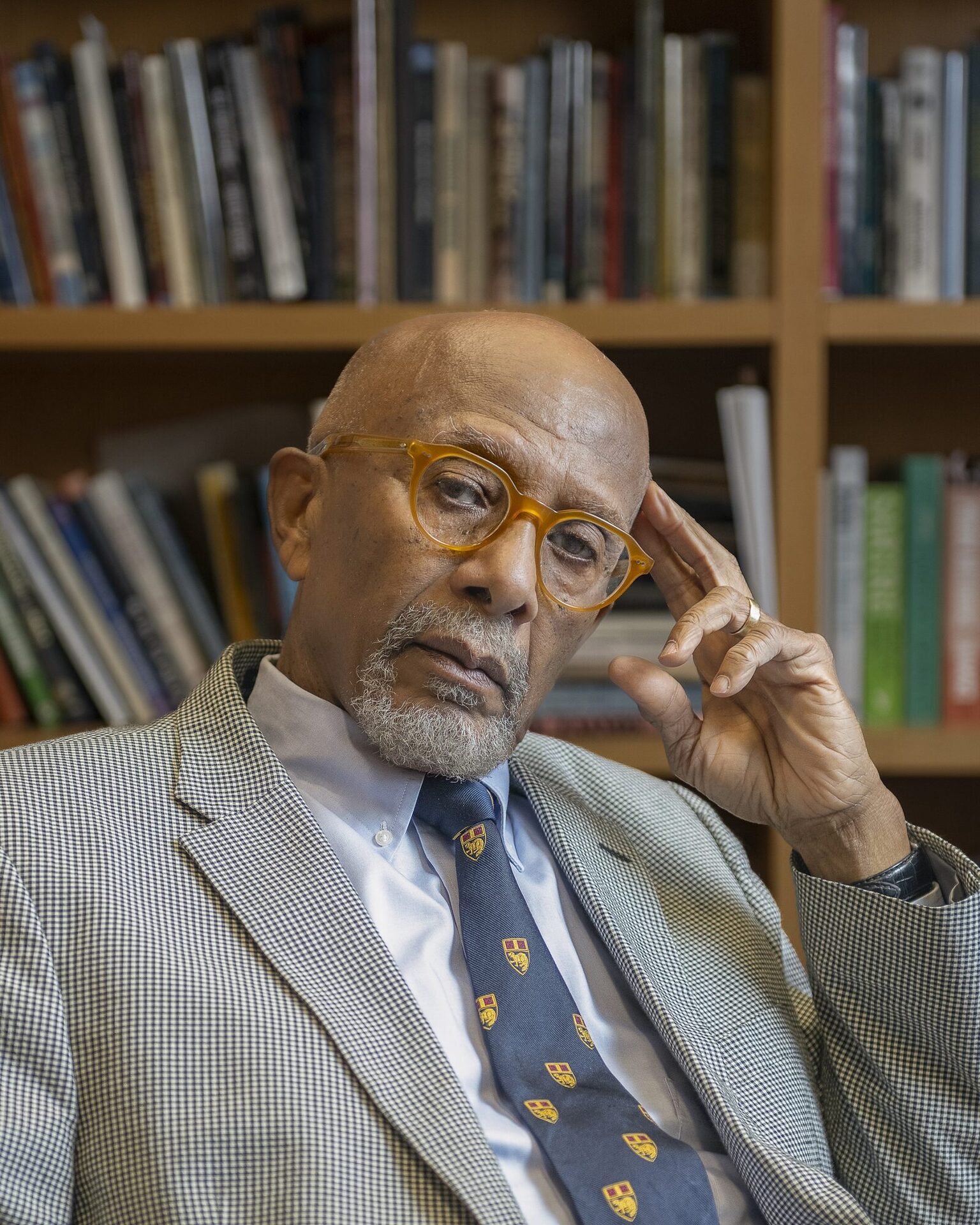
Professor Dr. Orlando Patterson was awarded the Hegel Prize 2024 by the City of Stuttgart. The state capital of Stuttgart thus honored one of the most important sociologists of our time, whose analyses and theories have also left a deep mark on philosophy.
Orlando Patterson is Professor of Sociology at the renowned Harvard University in the USA. In the United States, but also far beyond, he is one of the most important academic commentators on political and social conditions related to structural racism.
Award ceremony
The award ceremony took place on December 12, 2024 in Stuttgart City Hall:
Biography of Orlando Patterson
Orlando Patterson, born on June 5, 1940, is a Jamaican-American historian and sociologist and holds the John Cowles Chair of Sociology at Harvard University. He is known for his work on the history of slavery in the USA and Jamaica and on the sociology of development. His 1991 book "Freedom in the Making of Western Culture" won the US National Book Award for non-fiction.
He previously held faculty positions at the University of the West Indies and the London School of Economics, where he also received his Ph. His academic interests include the culture and practices of freedom, the comparative study of slavery, and the cultural sociology of poverty. Professor Patterson is the author of numerous academic articles and six major scholarly books, including "Slavery and Social Death" (1982), "Freedom in the Making of Western Culture" (1991), "The Ordeal of Integration" (1997), and "The Cultural Matrix: Understanding Black Youth" (2015).
Professor Patterson was Special Advisor on Social Policy and Development to Jamaican Prime Minister Michael Manley for eight years. He was a founding member of Cultural Survival, one of the leading advocacy groups for indigenous peoples' rights, and for several years a board member of Freedom House, a major civil society organization promoting freedom and democracy worldwide. The author of three novels, he has also published widely in opinion journals and the national press, notably the New York Times. His columns have also appeared in Time Magazine, Newsweek, The Public Interest, The New Republic and The Washington Post.
He is the recipient of numerous awards, including the National Book Award for nonfiction, which he received in 1991 for his book on freedom, and the American Sociological Association's Distinguished Contribution to Scholarship Award. He is co-winner of the Ralph Bunche Award for the best book on pluralism from the American Political Science Association. He also received the Anisfield-Wolf Book Award for lifetime achievement. He holds honorary doctorates from several universities, including the University of Chicago, UCLA and La Trobe University in Australia. In 1999 he was awarded the Order of Distinction by the Jamaican government. Professor Patterson has been a member of the American Academy of Arts and Sciences since 1991.
Awards and prizes (selection)
- 2020: Order of Merit, Jamaica
- 2016: Anisfield-Wolf Book Award, Lifetime Achievement
- 2015: Gold Musgrave Medal
- 1997: Walter Channing Cabot Faculty Prize, Harvard
- 1991: National Book Award, Non-Fiction
- 1983: Walter Channing Cabot Faculty Prize, Harvard
- 1983: Ralph Bunche Award from Howard University for the best scholarly work on pluralism (co-winner): American Political Science Association
- 1983: Distinguished Contribution to Scholarship (formerly Sorokin Prize): American Sociological Association
- 1965: Best Novel in English (The Children of Sisyphus): Dakar Festival of Negro Arts
Justification of the jury
Orlando Patterson is Professor of Sociology at the renowned Harvard University in the USA. In the United States, but also far beyond, Patterson is one of the most important academic commentators on political and social conditions associated with structural racism. The central theme of his research is slavery, whereby he deals intensively with both the history of slavery and its significance for the present. Patterson is primarily interested in the "sociology" of slavery, meaning not only values, beliefs and symbolic representations, but also the practices, habitus and attitudes that determine the basis and reality of institutions. Patterson's understanding of sociology or "culture", as he puts it, thus comes very close to Hegel's concept of morality. Very much in the Hegelian sense, Patterson asks about slavery as a cultural practice and the conditions of its constant reproduction.
This interest is exemplary and impressive of Patterson's important work, without which the current discussions on post-colonialism, structural racism and post-abolitionist conditions would be inconceivable: "Slavery and Social Death. A Comparative Study". In this book, Patterson says in 1982 that an enslaved person is "socially dead", that they have no existence in social reality as a symbolic normative order. This social death can be understood as a radicalization and deepening of Hegel's analysis of relations of non-recognition.
Patterson also associates Hegel with an interest in freedom, whereby Patterson raises the question of the extent to which freedom was only born out of the experience of its negation - slavery. Patterson develops this thesis in his second major work: Freedom (1991).
According to this, freedom is not a given or even a natural characteristic of human beings. In true Hegelian fashion, Patterson turns freedom into a collective, shared awareness of the (infinite) importance of freedom and the concept of freedom becomes its precondition.
It is remarkable how Orlando Patterson's investigations and questions extend far beyond the realm of narrow academic scholarship and transcend the boundaries of intra-academic discourse. Patterson's research and theories have also been discussed by a wider public on many occasions. He himself is one of the most prominent thinkers in the American public sphere.
In his work, Patterson poses fundamental questions about racism and social injustice and has thus had a decisive influence on the development of the humanities. The jury sees this as an achievement that deserves to be awarded the Hegel Prize of the City of Stuttgart due to its extraordinary independence and quality.
About the Hegel Prize
History
On June 8, 1967, the municipal council of the state capital Stuttgart established the Hegel Prize in recognition of the importance of its great son Georg Wilhelm Friedrich Hegel.
It is awarded every three years to personalities who have rendered or are rendering outstanding services to the development of the humanities in the broad sense.
The award is endowed with 12,000 euros. A jury decides on the award. It is not possible to apply for the award. The Hegel Prize is internationally regarded as one of the most important philosophical awards.
The jury
The jury consists of 4 experts. These are: Dr. Amrei Bahr Junior Professor of Philosophy at the Institute of Philosophy at the University of Stuttgart, Prof. Dr. Dina Emundts, President of the International Hegel Association and Professor of History of Philosophy at the Institute of Philosophy at the Free University of Berlin, Jürgen Kaube, co-editor of the Frankfurter Allgemeine Zeitung (FAZ) and responsible for the feature section there and Prof. Dr. Christoph Menke, Chair of Practical Philosophy with a focus on Political Philosophy and Philosophy of Law at the Goethe University Frankfurt.
The jury also included: Dr. Christine Lehmann, Bündnis 90/DIE GRÜNEN, Jürgen Sauer, CDU, Jasmin Meergans, SPD and Stefan Urbat, Die FrAKTION.
The head of the cultural department, currently Marc Gegenfurtner, is also entitled to vote. The jury is chaired by the Lord Mayor, currently Dr. Frank Nopper, or by the deputy mayor responsible for culture, currently Dr. Fabian Mayer.