Ten fields of action
The 2023 action plan "Sustainable and innovative mobility in Stuttgart" contains more than 200 individual measures that are to be implemented step by step. It thus defines the mobility objectives of the state capital Stuttgart for the coming years.
Traffic avoidance and modal shift
Avoiding traffic is the maxim that contributes significantly to the traffic turnaround. This is flanked by shifting unavoidable traffic to sustainable forms of mobility. In addition, a redistribution of public spaces can create more living and recreational areas in the city, which, among other things, creates more space and safety for children. The "city of short distances" - i.e. reducing distances to work, daycare or shopping - through deliberately mixed neighborhoods in urban planning also contributes to a successful traffic turnaround.
Roadsides play a key role here, as they can serve as delivery zones for commercial traffic during the day and as play and recreation areas in the evening, for example. Shifting traffic is therefore not just about redistributing financial resources to eco-mobility and prioritizing it, but also about redistributing and using areas in a completely new way.
Intermodality and networking
Inter- and multimodality means that a journey is made using several means of transport, preferably networked. Intermodal and multimodal transportation is an essential tool for reducing environmental pollution and relieving the burden on the public road network. The networking of different means of transport and their convenient and barrier-free accessibility for all people is of crucial importance.
The increasingly complex and individualized daily rhythm of us humans leads to the desire for these tailor-made mobility services and the availability of needs-based, fast, inexpensive and environmentally friendly means of transport.
In concrete terms, this means, for example, that traffic situation detection and control in the traffic control center in Stuttgart is to be expanded.
Public transportation
A well-developed and well-functioning public transport system and its active marketing are the backbone of any mobility concept that claims to be a genuine alternative to motorized private transport. Together with the partner means of transport in the environmental network, walking, cycling and pedelec traffic as well as innovative intermodal and multimodal offers, an attractive, alternative transport system must be guaranteed and further developed that is largely on a par with the MIV offer.
Professional transportation
Around 518,500 people were employed in the state capital Stuttgart in 2021. 58.5 percent of these employees live outside the state capital. Around 60 percent of them travel to work by car and usually alone (1.3 people per vehicle). In addition to these so-called commuters, the state capital of Stuttgart is also in discussion with companies and organizations about the traffic caused by the transport of products and services.
The 2023 action plan "Sustainable and innovative mobility", for example, provides for companies to be better supported in implementing their own mobility concept as part of company mobility management.
In-house mobility
A key task for sustainable mobility in Stuttgart is also the so-called "city's own transport". This is caused by the approximately 23,400 employees of the state capital (including the hospital), which provides a comprehensive and diverse range of services for its residents. By systematically analyzing and planning its own traffic flows, the state capital can make its own contribution to reducing motorized traffic and thus fulfill its pioneering role and responsibility in terms of sustainable mobility.
Mobility in the region
In the area of transportation, the municipalities in the Stuttgart region very often have to deal with identical problems. Closer cooperation is particularly necessary in the search for approaches and solutions. The state capital Stuttgart therefore proactively offers the municipalities and districts of the region as well as the Verband Region Stuttgart (VRS) an intensive exchange and a pronounced willingness to cooperate.
Motorized private transport
The aim of the measures with regard to motor vehicle traffic is to stabilize and stabilize motorized private transport. In addition, the careful use of public space and ensuring the efficiency of the reserved road network are of particular importance. The state capital particularly supports the shift towards electromobility.
Non-motorized traffic
Promoting non-motorized transport not only leads to a direct reduction in exhaust, pollutant and noise emissions and land consumption, but also to a much better quality of life and can contribute to a more attractive cityscape.
Commercial traffic
Residents want to shop, traders need goods, companies need materials and transportation for the goods they produce, waste needs to be disposed of and service providers need to be accessible to their customers. All of this generates traffic and at the same time ensures that the population is supplied. In short: commercial traffic ensures that the state capital of Stuttgart "works". It is essential for the daily life of each and every individual. That is why commercial transport also needs good framework conditions.
Public Relations
The diverse activities of the state capital in the field of sustainable mobility, thanks to which the quality of life is increased, should continue to be communicated by means of a uniform, broad-based and regularly repeated publicity campaign under the umbrella brand
"Stuttgart-steigt-um" umbrella (opens in a new tab) brand. All other measures contributing to sustainable mobility will also be communicated under this umbrella brand.
Measures implemented and completed
Many of the measures and projects described in the previous action plans have been implemented in recent years or have already been completed or established as permanent tasks. These include the measures and projects assigned to the individual fields of action:
Field of action 1 - Intermodality and networking
- Upgrading the control room of the IVLZ (integrated traffic control center)
- Traffic control and guidance (e.g. renewal of the northern network control system and further development of the IVLZ)
- Forum for all types of mobility (mobility subcommittee)
- Participation in the moveBW project (development of an app-based mobility assistant for mobility information and traffic control)
Field of action 2- Public transport
- Expansion of the bus and light rail network through network extensions, tangential lines and bus and express bus lines:
- U12 Remseck - Dürrlewang
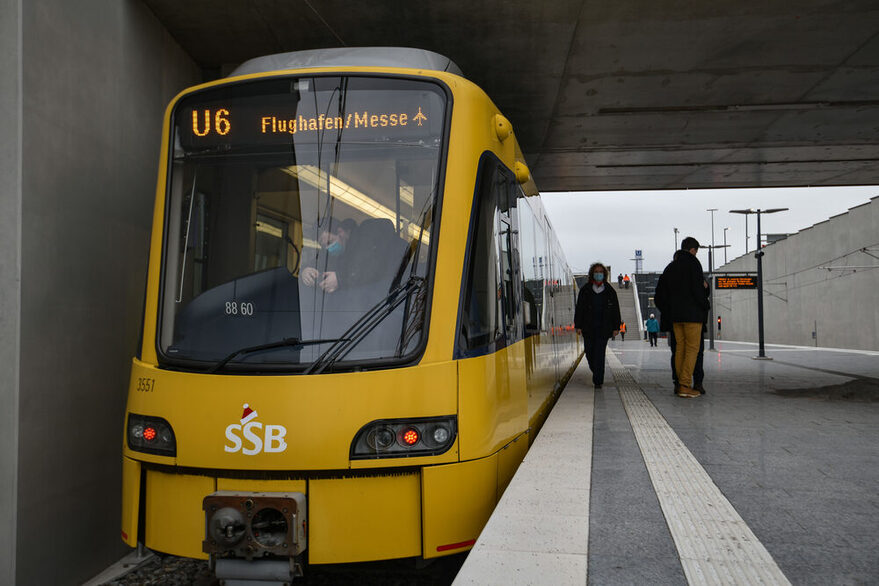
- U6 Airport
- U16 Fellbach - Giebel
- U19 Neugereut - NeckarPark
- Express buses X1, X2, X7 - Weekday night service with bus and/or SSB-Flex
- Expansion of the SSB control center
- Introduction of a uniform one-zone tariff for the entire state capital of Stuttgart (tariff zone reform 2019)
- Increasing the attractiveness of the 9 o'clock-UmweltTicket (e.g. by including it in the company ticket), 9 o'clock company subscription introduced in 2018
- Introduction of new ticket innovations:
- Best price billing
- 10-ticket
Field of action 4 - Urban transport
- Make cycling to work more attractive for employees by expanding the internal infrastructure required for the use of bicycles, pedelecs and e-scooters (e.g. changing areas, showers, secure parking spaces, etc.)
- Examine and, if necessary, implement whether business trips (including messenger services) can increasingly be carried out by bicycle, pedelec or cargo bike, on foot or by public transport. The offers of external car sharing providers or RegioRadStuttgart should also be included here.
- Updating the criteria for the allocation of municipal parking spaces for employees of the state capital Stuttgart and other user groups to reduce the number of journeys with conventional vehicles
- Mobility survey among employees of the state capital Stuttgart
- Provision of real-time traffic information at the workplace of city employees
- Personnel management measures to make working hours more flexible
Field of action 5 - Mobility in the region
- Check parking spaces for passengers
- All-day 15-minute intervals for suburban trains on weekdays
Field of action 6 - Motorized private transport (MIT)
- Continuation and expansion of 40 km/h on uphill stretches of the priority road network
- Extension of the 30 km/h speed limit in the priority road network in accordance with the amended German Road Traffic Regulations (StVO), particularly in front of kindergartens, schools and similar facilities
- Creation and implementation of a framework concept for e-mobility in public spaces (including legal, traffic-related and infrastructural principles, charging infrastructure, parking spaces)
- Further support and promotion of the conversion of the cab fleet and possibly other occasional services in the state capital of Stuttgart to e-drives (e.g. through specifications on emission classes when awarding concessions, if this is permitted under state law)
- "Scrappage bonus" funding program for two-stroke two-wheelers
- Creation of a stationary car sharing concept for the state capital Stuttgart and designation of car sharing parking spaces in public areas
- City2Navigation" project (successor project NAVIGAR)
- Traffic circles to stabilize vehicle traffic (e.g. Solitude-/Engelbergstraße in Weilimdorf)
Field of action 7 - Non-motorized transport
- New construction of the Westbahnhof youth transportation school (replacement for Diakonissenplatz)
- Development of an inter-municipal, regional bicycle and pedelec rental system (RegioRadStuttgart) including cargo bikes and the possibility of an event fleet (merging the local bicycle rental system call-a-bike with the regional rental system NAMOREG E-2-R)
- Establishment of a pedestrian officer analogous to the cycling officer
- Testing of pedestrian traffic lights without compulsory use
Field of action 8 - Commercial transport
- Pilot project "Digital delivery zone management"
Other measures
- Introduction and evaluation of the particulate matter alarm in conjunction with an extensive information and communication campaign and the central website www.feinstaubalarm.stuttgart.de (since January 2016)
- Pilot test on the effectiveness of moss walls to reduce air pollutants (since October 2016)
- Continuation of the first test project "Street cleaning particulate matter" from spring 2017 over the entire particulate matter season 2017/2018. A decision on whether the trial will then become a permanent measure will be made in summer 2018 after the evaluation of the second test phase.