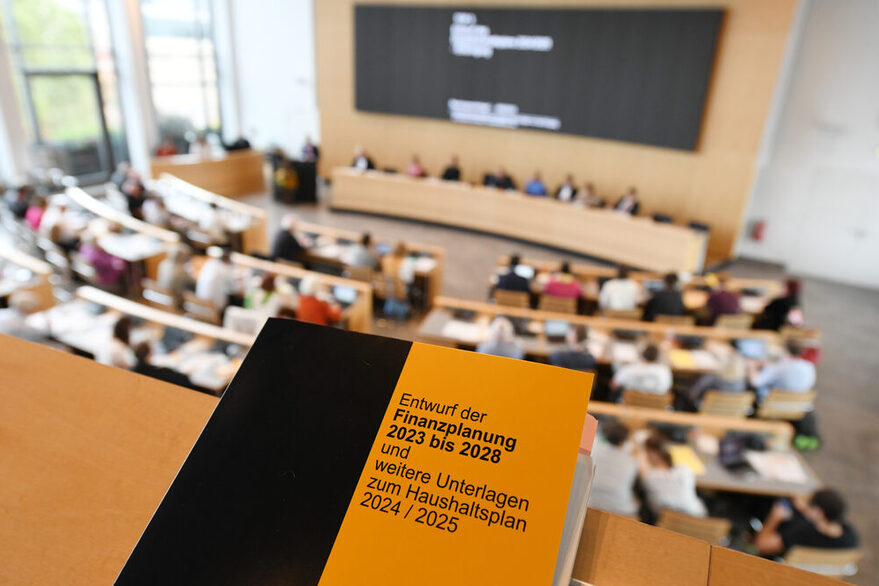
The Baden-Württemberg municipal code stipulates that local authorities must draw up a budget for each year. However, a so-called double budget is also permitted. Drawing up a budget for a large city like Stuttgart is a complex process. All municipal departments are involved. The state capital Stuttgart has therefore drawn up a double budget every two years since 2000. Income, expenditure and investments are thus planned for two years. Many large cities in Germany now do this.
Since 2011, the residents of Stuttgart have also been able to contribute their ideas every two years via the participatory budget. It is now one of the most successful citizen participation schemes of its kind in Germany.
The current 2024/2025 double budget was adopted by the municipal council on December 15, 2023.
Budget
Many private households keep a budget book in which they note their income and expenses in order to plan their finances. The city's budget works no differently, only with many more items. And: The city must set its budget in advance. According to Section 79 of the Baden-Württemberg Municipal Code, municipalities are required to draw up a budget.
The budget is the basis for managing financial resources. It contains the anticipated income and expenses for all municipal tasks, as well as investments and their financing. The municipal council and administration must adhere to this plan.
A whole series of annexes are attached to the budget. These include, among other things, the business plans of Stuttgart's own operations, such as the public swimming pools or waste management. Another part is the staffing plan. It shows how many staff positions are required in which areas of the administration in order to fulfill the city's tasks.
Planning and adoption
The city treasurer's office first prepares a draft for the double budget together with the specialist departments and the city's own companies, such as Bäderbetriebe or Abfallwirtschaft Stuttgart. It calculates the expected income and expenditure for current tasks and determines the financial requirements for investments.
There is a historical peculiarity here: two lists are initially drawn up for the planning of the double budget. The lists are divided into the colors red and green. The "red list" contains the projects that are reported to the city treasury as urgent by the specialist departments. The top management then draws up a "Green List", which receives investments and budget increases from the "Red List". The "Green List" is part of the draft budget, which also consists of updated measures and legal obligations.
The Lord Mayor and Finance Mayor present this draft to the municipal council in the fall, which examines the proposal. In a general public debate, the parliamentary groups submit their own proposals with wishes and priorities for the coming years. They can also include proposals from the participatory budget in these motions.
In November, the Administrative Committee discusses the proposals and the original draft budget at first and second readings. At these meetings, the councillors also discuss the proposals from the participatory budget. The third reading of the budget then takes place in the municipal council in December. At this meeting, the councillors make a final decision on what will and will not be included in the budget. This meeting is open to the public, i.e. it can be attended by members of the public.
Approval of the budget
The city must submit the adopted budget to the Stuttgart Regional Council for approval. The regional council is the central state authority between the state government and the municipalities and has legal supervision over the municipalities (opens in a new tab).
When examining the budget, the regional council pays particular attention to ensuring that the city complies with all legal requirements, that the long-term financial capacity of the administration is ensured and that the planned investments are realistic and sustainable.
Following successful approval, the budget is made public so that all interested parties can view it.
Budget structure
The budget is divided into an operating budget and a financial budget and is subdivided into so-called sub-budgets of the various offices.
Results budget
Financial budget
Budgets from 2012
Debt
Despite careful planning and responsible budgeting, it is sometimes necessary to take out loans and thereby incur debt. This can be particularly useful when important investments are pending. However, debt limits the capacity of a municipality and should therefore be used as little as possible.
By 1993, the state capital of Stuttgart had accumulated a record debt of 1.154 billion euros. Because Stuttgart has made intensive efforts to repay loans in recent years, it has been possible to gradually reduce the debt.
Financial statements
Annual financial statements are prepared after each financial year to reflect budgetary management. In doing so, the municipality gives an account of how the budget requirements adopted by the municipal council have been implemented. The financial statements of previous years are available for public inspection by citizens.
Financial statements from 2012
City Treasurer's Office
