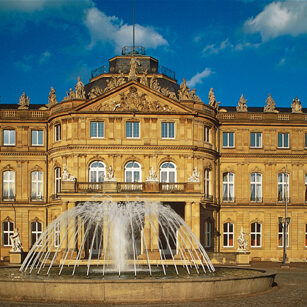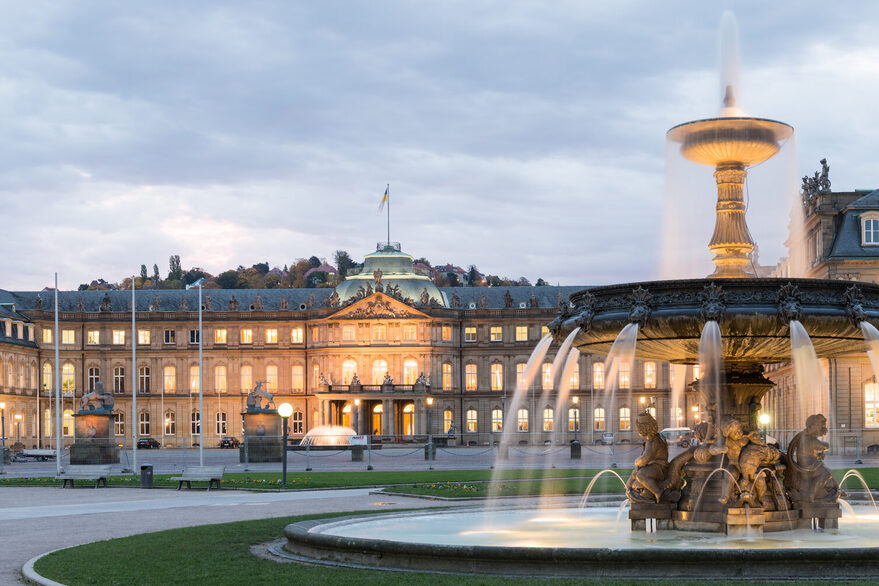
When Duke Carl Eugen von Württemberg came to Stuttgart in 1744 at the age of 16, the Old Palace no longer met his requirements and a new seat of power was needed. He even threatened to move his court to Ludwigsburg if he did not.
Carl Eugen commissioned the Italian architect Leopoldo Retti to design a three-winged complex with a large cour d'honneur. Completion ultimately took until the 19th century after the duke's death. The New Palace is therefore characterized by the coexistence of different eras and styles: from Baroque to Rococo to Classicism. The kings of Württemberg resided in the New Palace until around the middle of the 19th century.
Seat for kings and ministries
After the New Palace was severely damaged in World War II, the reconstruction of the building was initially controversial - it was almost even demolished. It was not until 1957 that the state parliament of Baden-Württemberg decided to rebuild it - with only one majority vote. This construction phase also had an impact on the appearance of the castle. Among other things, the wing facing the palace garden was painted pink and the large crown that had been on the dome gave way to the Baden-Württemberg state flag.
The eventful history of the palace is also reflected in its inhabitants: not only dukes and kings lived here. Former German President Richard von Weizsäcker was also born in an attic apartment in the New Palace on April 15, 1920. Today, the New Palace houses two ministries and, in the basement, the Roman Lapidarium of the State Museum. Those who wish to marry in the New Palace can do so in the magnificent Marble Hall.