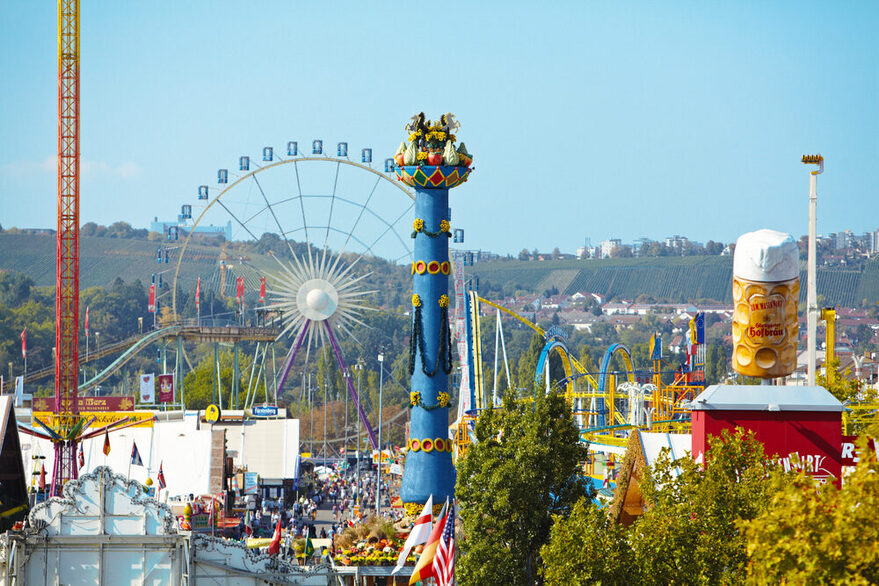
The Cannstatt Folk Festival from late September to early October has a long tradition. In 1818, an agricultural festival was celebrated for the first time on the Wasen at the request of King Wilhelm I of Württemberg. Today's light-hearted hustle and bustle has serious origins: When the Indonesian volcano Tambora exploded in 1815, it threw so much gas and dust into the atmosphere that it changed the climate for years - even in the faraway kingdom of Württemberg. What followed was a year without summer, failed harvests and famine.
King Wilhelm I then made it his task to reform agriculture. The 1818 festival on the Wasen was to be a sign of hope. The Fruchtsäule, a wooden column decorated with fruit, became the symbol of the festival. The festival has remained true to its agricultural tradition: every four years, the main agricultural festival is held alongside the folk festival. Today, the majority of visitors are attracted by the rides as well as the festival tents. Around four million people visit the Cannstatt Folk Festival every year, which is also quite pragmatically named after the location of the event in the vernacular: "der Wasen".
Stuttgart Spring Festival smaller than "the Wasen
The Stuttgart Spring Festival takes place annually between mid-April and early May and is the counterpart to the Cannstatt Folk Festival. It is smaller in area than "der Wasen" in the fall, but lasts about a week longer. Up to 240 businesses, including four marquees, numerous rides and booths, expect around one million visitors every year. It is considered the largest spring festival in Europe.
The question still remains to be answered: Why Cannstatter Wasen but Stuttgart Volksfest? The answer can be found in the founding year of the events: When King Wilhelm I established the folk festival in 1818, Bad Cannstatt was still independent. When the spring festival was celebrated for the first time in the 1930s, Bad Cannstatt already belonged to Stuttgart.