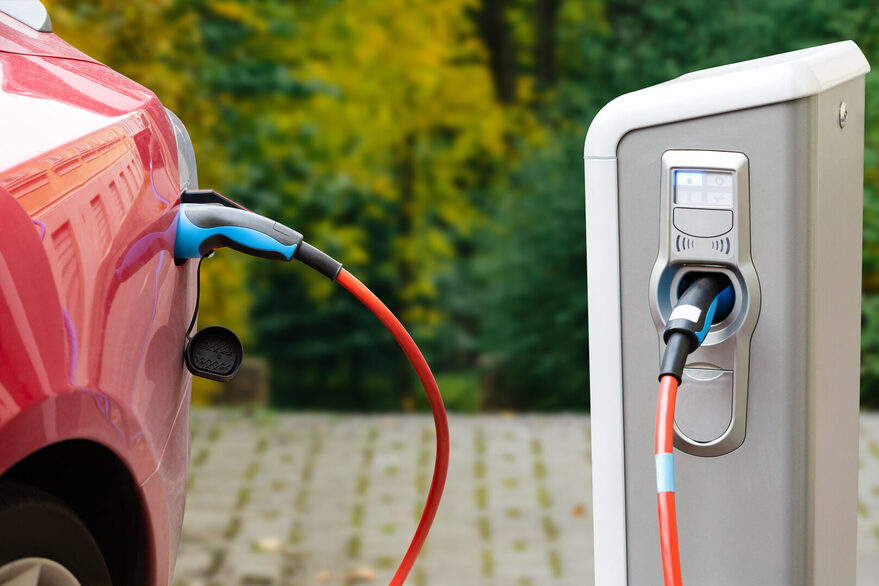
Stuttgart promotes electromobility. We support you in setting up charging options for electric vehicles on private premises. Benefit from the funding and contribute as a private individual, building management company or association to the drive turnaround in Stuttgart.
Implement private charging infrastructure with city subsidy.
For homeowners' associations (WEG), the state program charge@bw (opens in a new tab) is also an option. Until the end of 2025, this will subsidize the upstream charging infrastructure with 40 percent of the costs incurred, up to 2,500 euros per parking space. This also applies to parking spaces that do not yet have a wallbox installed.
With the private charging funding guideline, the city of Stuttgart supports building owners, tenants, leaseholders and service providers in setting up charging infrastructure. In particular, the cooperation of several owners, e.g. in homeowners' associations, or the electrification of parking spaces without an existing grid connection is supported.
In addition, the use of urban areas is made possible as a last resort for new house connections for charging points if the charging infrastructure cannot otherwise be supplied with electricity.
This program is only aimed at projects in which it is not possible or sensible to connect the charging infrastructure to photovoltaics . This funding program is a supplement to the Stuttgart solar offensive.
Irrespective of this, the costs of a pre-check of your property by a qualified specialist company will be covered in the amount of €110.
Please note
The current funding period ends on December 31, 2025. Applications received by this date will be processed, approved and paid out. The municipal council will decide whether to continue the funding program as part of the deliberations on the 2026/27 double budget.
Promotion details
Who can submit an application?
Private individuals, companies or associations that have a property in the Stuttgart city area.
What is promoted?
a) Upstream charging infrastructure for electromobility.
Funding is possible if at least two charging points in the overall system are supplied by the upstream charging infrastructure and at least one of them is installed during the funding period (max. 24 months). Commercial use must not predominate.
Upstream charging infrastructure includes:
Empty conduits and cable routes from the house junction box via the sub-distribution to the parking spaces where e-charging facilities are intended to be installed
Supply line to the subdistribution
Sub-distribution, power and data lines to the parking spaces
Upgrading and installation of meter and control cabinets
Wall penetrations
Installation of a grid-serving load management system taking into account user behavior, including charging management hardware
Upgrading of an existing house connection
If a house connection is not yet available (e.g. in the case of detached rows of garages): Installation of a house connection (incl. civil engineering and foundation work).
Not included in the upstream charging infrastructure:
The charging station itself (wallbox or charging pole). If necessary, this can be subsidized via other programs, provided that these allow a combination with other subsidy programs.
b) Use of public areas for house connections of garage rows
Detached garage rows are often built directly onto the property line. However, a connection to the power grid is usually not allowed inside the garage. Thus, there is often a lack of areas to provide power to garages.
We want to support garage owners with electrification: the city allows the use of adjacent municipal land to set up a new house connection for charging infrastructure if this cannot be set up on private land.
For this permission, the city of Stuttgart initially waives permission fees for 10 years. This waiver can be extended after renewed examination.
The use is regulated after examination by the land administration office by a permission contract.
House connection for charging infrastructure not possible on private area
Adjacent urban area
Examination by technical office
c) Pre-check electromobility
A pre-check by a qualified electrical installation company is a prerequisite for the safe and needs-based installation of charging infrastructure. The potential for the installation of charging infrastructure is determined and the technical requirements are checked.
The city of Stuttgart pays a flat rate of 110,00€ of the costs for the execution of a pre-check.
Prerequisites:
Submission of proof that a pre-check has been carried out by a certified service provider.
A list of qualified specialized companies can be downloaded here:
Investment costs for the upstream charging infrastructure are subsidized:
Funding is provided for up to 50% of the eligible costs, up to a maximum of €30,000 per project. This can be made up of:
a maximum of €1,000 per newly constructed charging point that is supplied with electricity by the upstream charging infrastructure
a maximum of €250 per charging point that can potentially be supplied with electricity by the upstream charging infrastructure
maximum 5.000€ for the upgrading of a grid connection, for new charging infrastructure
maximum 5,000€ for the construction of a new grid connection for new charging infrastructure.
The actual funding amount will then be determined based on the costs resulting from your installation company's quote.
Example:
You want to equip one parking space with a wallbox, and two others are being prepared for the subsequent connection of a wallbox. You have received an offer with total costs of 5,000 €. Of this, €1,000 is for the wallbox itself.
Eligible costs: €4,000 (as the wallbox does not count towards the upstream infrastructure).
Maximum funding amount: Initially 50% of the costs, i.e. €2,000.
One charging point is installed and two parking spaces are prepared:
1.000 € + 2 x 250 € = 1.500 €. In this case, the funding amount is 1,500€.
What's behind the promotion?
The funding for private charging is a further building block for the state capital of Stuttgart on the road to climate neutrality. The funds were made available through the climate protection action program.
The €200 million climate protection action program (opens in a new tab) "World climate in need - Stuttgart takes action" will initially provide €453,000 in funding from 2022. In 2023, the funding was increased by a further €1,077,000 until the end of 2023. The funding is to be continued beyond this date.
The action program aims to increase climate protection activities and contribute to the city becoming climate-neutral by 2050 at the latest. The mobility sector has an important role to play in achieving the city's climate protection goals. Increasing the number of charging points in the private sector will relieve the burden on the public charging infrastructure and give more people the opportunity to switch to less climate-damaging vehicles.
The city itself is leading by example in the switch to electromobility. For example, the city's own cars are almost exclusively being replaced by purely electric vehicles. As a result, several hundred of the city's combustion engines have already been converted to electric vehicles. At the same time, the city is creating charging infrastructure at depots and providing space for publicly accessible charging infrastructure (opens in a new tab).
Above you can download the funding guidelines for private charging and the application form. The form is a combined form for the various components of the funding.
Please send the completed form including the required attachments by e-mail to: eladenstuttgartde
Or by post to:
ELaden Energy concept for the entire city Gaisburgstraße 4 70182 Stuttgart
If you have any questions about the program or the procedure, please get in touch with the contact persons listed below.
What to do before and after the application?
1. look for allies
First, think about your requirements for the charging infrastructure. To do this, approach rental owners and your property management in your WEG. Contact other owners in a garage row. For these first steps, also take advantage of our free initial consultation (opens in a new tab).
2. pre-check by an electrical installation company First of all, it is advisable to commission a qualified electrical installation company to carry out an initial check (pre-check).
This involves checking your existing electrical installation in the house to ensure safe operation. As a rule, it must be checked to what extent your previous mains connection has sufficient residual capacity for charging an e-car. Depending on the previous load, reinforcement may be necessary, especially in apartment buildings. In detached garages, a new house connection may be necessary. Reinforcement or new installation must be registered or applied for by your electrician with the network operator.
In addition, the electrical installation company will check to what extent your existing electrical installation is suitable for the permanently safe charging of an e-car.
You can apply for a subsidy for this pre-check after it has been carried out using our form.
3. get a quote
Obtain a quote for the installation of charging infrastructure by an installation company. This is the basis for an application. If necessary, also obtain a quote from Stuttgart Netze for the installation / reinforcement of a house connection.
4. apply for subsidies
Apply for subsidies before commissioning an installation. It is not possible to apply for measures that have already been commissioned.
After you have submitted the application, you will receive a clearance certificate from us and can already commission your installation company at your own risk. After a successful review, you will receive a funding decision from us.
Order the installation of the charging infrastructure from your electrical installation company.
5. register with the network operator (Stuttgart Netze).
If you plan to create an initial charging facility with a capacity of up to 12 kW, a notification to the grid operator is sufficient.
If you want to set up a charging facility with an output of more than 12 kW, or several with a total of >12 kW, you need a permit, which is applied for from the grid operator.
The grid operator checks your application and reports the result to you and your electrical installer.
If measures are required to reinforce your grid connection, you will receive an offer from the grid operator for the costs incurred. The charging infrastructure may only be installed after reinforcement.
6. after positive feedback: Installation and commissioning
If no further measures are necessary, you will receive a connection commitment from the network operator valid for four months. During this period, your electrician can install your charging equipment and report commissioning to Stuttgart Netze.
7. apply for payment
After commissioning your charging infrastructure, you can submit an application for disbursement to us. After receiving the funding decision, you have 24 months to submit the application for payment. After your application has been successfully reviewed, we will transfer the subsidy to you.
Do you need help?
Questions about the funding program and the application process can be sent by email to eladenstuttgartde.
This website has been automatically translated by DeepL. No personal data is transmitted to the service provider when the pages are accessed. All translated content is stored locally on the web server of the state capital Stuttgart and delivered via this server. Machine translations may differ from the original text. No guarantee can be given for the accuracy, completeness and up-to-dateness of the translation.