Electrically powered vehicles
The number of electrically powered vehicles in Stuttgart is steadily increasing. The city administration is promoting electric mobility through funding and advice in order to achieve climate neutrality by 2035.
Is an electrically powered vehicle worth it for me?
Depending on your needs, you can opt for different types of vehicle. A battery-powered electric car or a fuel cell car can replace an existing car with a fossil combustion engine. Switching to e-bikes, e-cargo bikes or even e-motorcycles can also be cost-effective and environmentally friendly in many cases.
You can find out whether an electric car is worthwhile for you according to your individual requirements with the help of cost comparison calculators from various providers. This can include distance requirements, mileage, fuel costs and environmental aspects such as CO2 emissions.
Comparisons have shown that the total cost of an electric vehicle is often cheaper than comparable petrol or diesel vehicles. Here you can find, for example, a survey by the ADAC (opens in a new tab).
Funding opportunities for electric cars are listed in this funding database (opens in a new tab), or can be presented on request by the initial electromobility advisory (opens in a new tab) service.
We also offer additional funding opportunities for e-trikes and e-cargo bikes.
Is photovoltaics a sensible addition to an electric car?
Photovoltaics and e-mobility can work very well together. By purchasing and installing a photovoltaic system together with an electric car, you can achieve synergy effects. This allows you to use cheap and sustainable electricity for the vehicle.
This also increases the proportion of self-consumption in energy generation by the PV system. This means you can use the low-cost PV electricity yourself. Compared to feeding it into the energy grid, which is remunerated at relatively low prices, this is a more efficient use.
In the future, the car can also serve as an energy storage system to feed electricity back into the (domestic) grid when needed (vehicle to grid, vehicle to home).
The city is also promoting photovoltaics and the installation of associated charging infrastructure as part of the "solar offensive".
Charging infrastructure in Stuttgart
The charging infrastructure in Stuttgart is differentiated between public, semi-public and private charging infrastructure.
Public charging infrastructure
Charging infrastructure on public roads is accessible to everyone around the clock.
There are currently more than 3899 charging points on the network in Stuttgart, 186 of which are fast charging points. These include over 1,000 charging points on public streets. This means that Stuttgart has the densest charging network of any major German city.
In order to create competition, the locations in Stuttgart were put out to tender. Three operators emerged from the process: EnBW, eze.network and Stadtwerke Stuttgart. A further 500 charging points were approved by the municipal council and are now being implemented by the administration.
Public charging points comply with the requirements of calibration law to ensure that only the electricity actually purchased is charged for. Further information on the charging points in public areas and the current expansion and concept of the state capital can be found on our page on public charging points (opens in a new tab).
Parking during the charging process is free of charge. Depending on your charging tariff, a private "blocking fee" may be charged by your provider.
Semi-public charging infrastructure
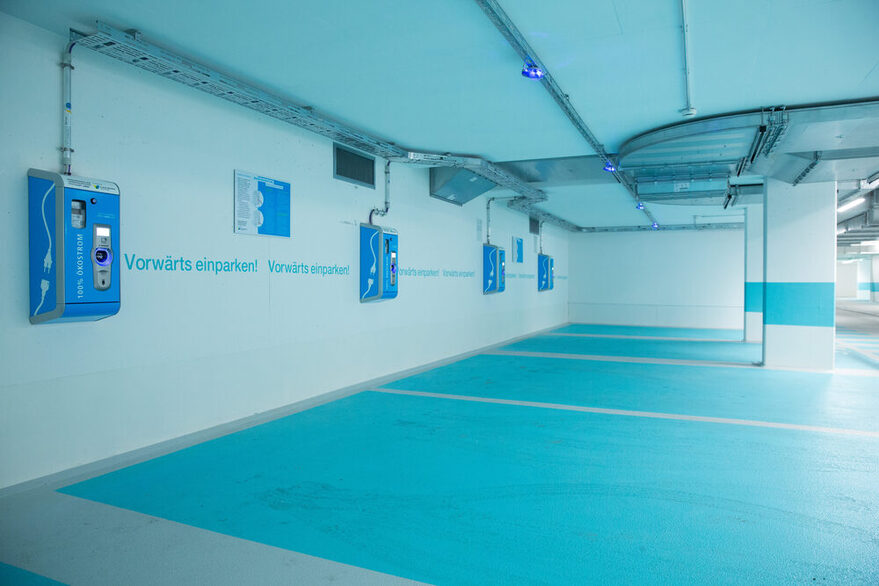
Semi-public charging infrastructure can be found in privately managed street space, e.g. parking lots, petrol stations or underground garages. It can be of unrestricted or limited public use. If it can be used by the public, it must comply with the requirements of calibration law.
The City of Stuttgart has only limited influence on these charging points. The City of Stuttgart also operates charging infrastructure in its own parking garages.
Private charging infrastructure
Private charging infrastructure on private land is only available to a limited group of users. This charging infrastructure does not have to meet the requirements of the calibration law.
The state capital supports the installation of private and semi-public charging infrastructure with advice and funding ( solar offensive funding, private charging).
Public and semi-public charging infrastructure
How many charging stations are there in Stuttgart?
The first major expansion phase with AC charging points in public spaces has recently been completed in cooperation with the operators. There are now around 500 roadside charging points for electric cars in urban areas. This corresponds to around 1,000 charging points. There are also a large number of charging stations in semi-public spaces (e.g. in parking lots, at train stations, in underground car parks or at petrol stations).
According to the Federal Network Agency, (opens in a new tab)a total of 3899 charging points are publicly accessible in Stuttgart as of July 2025. More charging points are being added all the time. This makes Stuttgart the leading German city in relation to its population.
This is supplemented by charging infrastructure on private land, which is generally only available to a limited number of users and the number of which is not currently recorded. DC fast chargers on public roads are also being added: 20 locations were put out to tender and have now been awarded to future operators in four lots.
Additional fast-charging hubs are planned as part of the German network (opens in a new tab). Four search areas on traffic axes concern Stuttgart. The implementation of the fast-charging hubs will take place in the coming years.
Where can I find e-charging stations?
An overview of all charging options available in Stuttgart and beyond the city limits can be found, for example, on the map on the emobil Region Stuttgart website (opens in a new tab) from GoingElectric.
We also offer an overview of the charging points on public roads and newly planned locations, as well as general information on the charging infrastructure in Stuttgart.
In addition, the respective mobility service providers (e.g. EnBW (opens in a new tab), Stadtwerke Stuttgart (opens in a new tab), etc.) usually also offer their own maps with available charging stations in apps for your mobile device or on the respective websites.
How can I use the charging infrastructure in public spaces?
You can charge both contract-based and ad-hoc at the charging stations in Stuttgart.
Authentication at a charging station is usually carried out by a mobility service provider. To do this, you must conclude a contract with such a service provider. This allows you to charge at all charging stations in the operator's charging network according to the operator's tariff (roaming). These providers also offer their own apps that show users nearby charging points and their status.
The charging station can then be activated either by RFID card or via an app. Since July 2024, newly installed charging stations must also have an EC card terminal with which a charging process can be started and billed ad hoc.
Information on concluding a contract with one of these service providers can be found on the website of the respective company.
Alternatively, you can also charge ad-hoc. This means: spontaneous, contract-independent and without a charging card or app. Charging then takes place at the charging station operator's tariff.
Is there a charge for parking while charging?
Parking during the charging process is free of charge even after the exemption from charges for electric vehicles expires on 31.12.2022. A parking ticket does not have to be purchased for this, as stipulated in Section 13 (5) sentence 1 of the German Road Traffic Act (StVO). (opens in a new tab)
Depending on your charging tariff, a "blocking fee" may apply via the provider of the charging station or your charging card. If you start the charging process via a QR code on the charging station, the so-called ad hoc tariff of the charging station operator applies. If you use a charging card, for example, the tariff of your contractual partner applies.
The "blocking fee" is a time component in the charging tariff, which applies either after a certain standing time at the charging station or after the end of the charging process. The regulation varies depending on the provider.
These are intended to prevent charging stations from being blocked by vehicles that are no longer charging, thus denying other users access.
Traffic law violations are also punished by traffic control.
How much does it cost to charge and are there different rates?
Various factors play a role here: The cost of a charging process depends on the size of your battery, the charge level and the tariff of your mobility service provider.
There are different charging tariffs. The charging infrastructure operators only set the access fees for the mobility service providers. The end customer prices are then set by them.
You will also receive an RFID card from your mobility service provider , which you can use to initiate the charging process at the stations. Alternatively, this is also possible via an app. However, you can also charge your vehicle at an ad hoc rate without a contract with a mobility service provider.
There are various models: electricity is usually billed according to the number of kWh (kilowatt hours, i.e. the amount of energy used). A roaming fee may also be charged. Some providers also charge a"blocking fee" after a certain charging time. Further details can be found in the information provided by the service providers.
The city of Stuttgart ensures competition between the various providers by having several providers operate charging stations in municipal areas in Stuttgart.
What can I do if a charging station is blocked by a combustion engine?
In this case, you can contact the traffic monitoring department of the city of Stuttgart to report a violation.
The incident can then be recorded by the contact persons responsible there. When reporting by mail, you should include the place and time of the violation.
The administrative offense is normally punished with a fine, the amount of which corresponds to the currently valid fine catalog. The responsible officers of the Stuttgart police can arrange for an incorrectly parked vehicle to be towed away.
New public charging stations
When and where will charging stations be installed in the future?
In the first major expansion phase, charging points were installed at around 500 roadside locations. The locations were distributed across the city districts depending on the number of residents and employees.
The locations were presented to the respective district advisory council following on-site inspections. Once this expansion phase is complete, there will be around 1,000 charging points available on public roads alone.
In 2024, the municipal council decided to invite tenders for a further 500 locations, thus doubling the available charging infrastructure in public spaces in the coming years. Preparations for this second expansion phase are underway.
We are providing a map of planned and already available locations on public streets and information on the ongoing process.
Can I suggest locations for charging stations?
It is currently not possible to apply for the installation of a charging station on a public road. So far, locations have been selected with regard to their predicted use and with consideration for other road users, the power grid, other lines and the attractiveness of the location.
The expansion of the charging network in Stuttgart is based on a framework concept from the city council (opens in a new tab). The first 500 locations were implemented on this basis.
The construction of a further 500 locations was approved by the municipal council (opens in a new tab) and is currently in preparation. Further locations will be put out to tender once the preliminary planning has been completed.
Private charging infrastructure
Where can I find basic information about charging my vehicle?
A comprehensive overview of the charging infrastructure for electromobility can be found in the technical guide to electromobility (opens in a new tab).
An overview of relevant information for consumers can be found at e-mobil BW (opens in a new tab).
How does the city of Stuttgart promote electromobility?
In addition to our consulting services , the city of Stuttgart offers a funding program:
As part of the solar offensive , we promote the upstream charging infrastructure of wallboxes in conjunction with a photovoltaic system, among other things. Without a combination with a photovoltaic system, funding is possible in the private charging program for several parking spaces or more
The purchase of e-trikes and e-cargo bikes is also supported.
Can I run a cable across sidewalks while charging?
In consideration of the road safety of all road users and accessibility, it is generally not permitted to lay a charging cable across public traffic areas. A charging cable on the sidewalk endangers people with limited mobility in particular, but also cyclists or people with baby carriages, etc.
Laying cables using cable ducts, cable bridges, swivel arms or similar solutions cannot be approved in view of the current legal situation. If accidents occur due to private charging cables, the person responsible can be held liable for breach of the duty to maintain road safety. Violations are also recorded by the public order office.
The crossing of public green spaces may be approved in individual cases after examination by the relevant authorities.
Please contact emobilitaet@stuttgart.de for more information emobilitaetstuttgartde emobilitaetstuttgartde
Can I charge privately on a public parking space?
Not as a rule.
As public space is strictly separated from private space, it is not possible to permanently use a public parking space (i.e. one that can be used by everyone to the same extent) for private charging. The privatization of public parking spaces for private use is generally not possible, or in justified individual cases (e.g. neighbourhood stores) requires a municipal council resolution.
For reasons of road safety , it is also not permitted to lay private cables across footpaths or roads. This endangers people with limited mobility in particular, as well as children, cyclists and people with baby carriages. Solutions involving cranes or covers for the cables are also not approved due to traffic safety issues.
If you already have a permanently rented parking space, it is possible to create a charging facility in individual cases. This requires an examination by the relevant authorities. Please contact our initial consultation service.
Ways to your own charging facility
As a tenant, do I have a right to a charging facility?
Tenants have had a new legal entitlement since December 2020:
According to Section 554 of the German Civil Code (BGB) (opens in a new tab), a tenant can demand that they be permitted to make structural changes to the rented property that are necessary for charging electrically powered vehicles.
This right exists not only for tenants of residential property, but also for tenants of land and non-residential property (Section 578 I, II BGB). A contractual exclusion of these rights is not possible. The landlord can undertake to provide the landlord with a special security (cf. deposit).
The landlord must tolerate these structural alterations unless the landlord cannot reasonably be expected to accept the structural alteration, even when the tenant's interests are taken into account.
It should be noted that you as the tenant bear the costs incurred. If you want to set up a charging infrastructure as a tenant, the city's initial consultation service will help you free of charge.
As a co-owner in a condominium association, do I have a right to a charging facility?
In principle, co-owners are entitled to make structural changes in order to install a charging point.
In December 2020, the Condominium Modernization Act (WEMoG) came into force, which amended the Condominium Act (opens in a new tab). These changes brought with them new regulations in the area of electromobility, among others.
A unanimous resolution is no longer required for structural changes to the common property. A simple majority of the votes cast at a convened homeowners' association is sufficient.
If such a majority is achieved, the approving parties bear the costs of the alteration. If the application is approved by two-thirds of the votes and half of the co-ownership shares, or if the costs are amortized within a reasonable period of time, all condominium owners must bear the costs of the structural changes. Unless this is associated with disproportionate costs.
However, even if no majority is reached for the application, the structural alteration can still be implemented: the party or parties willing to make the structural alterations can submit an application for the implementation of appropriate structural alterations that serve to charge electric vehicles (Section 20 II No. 2 WEG). This claim can also be enforced in court (§44 I S.2 WEG). The costs are to be borne by the parties willing to build.
It is advantageous to inform the other parties about the project at an early stage in order to solicit s Condominium Act (opens in a new tab). These changes brought with them new regulations in the area of electromobility, among others.
A unanimous resolution is no longer required for structural changes to the common property. A simple majority of the votes cast at a convened homeowners' association is sufficient.
If such a majority is achieved, the approving parties bear the costs of the alteration. If the application is approved by two-thirds of the votes and half of the co-ownership shares, or if the costs are amortized within a reasonable period of time, all condominium owners must bear the costs of the structural changes. Unless this is associated with disproportionate costs.
However, even if no majority is reached for the application, the structural alteration can still be implemented: the party or parties willing to make the structural alterations can submit an application for the implementation of appropriate structural alterations that serve to charge electric vehicles (Section 20 II No. 2 WEG). This claim can also be enforced in court (§44 I S.2 WEG). The costs are to be borne by the parties willing to build.
It is advantageous to inform the other parties about the project at an early stage in order to solicit support for the project. It also makes sense to have the feasibility checked by an electrical installation company and to have a cost estimate drawn up.
I would like to install a wallbox in my garage or parking space. How do I proceed?
1. testing by an electrical installation company
First of all, think about the requirements for your charging infrastructure. You are also welcome to take advantage of the free initial consultation . It is then advisable to commission a qualified electrical installation company to carry out an initial inspection of your building.
As a rule, it must be checked to what extent your existing grid connection has sufficient residual capacity for charging an electric car. Depending on the current capacity utilization, an increase may be necessary, especially in apartment buildings. In detached garages, a new house connection may be necessary. Your electrician must register/apply for a reinforcement or new installation with the grid operator (opens in a new tab).
The electrical installation company will also check to what extent your existing cables and fuses are sufficient for the long-term safe charging of an electric car.
Stuttgart Netze offers a list of qualified electrical installation companies in Stuttgart (opens in a new tab) for this purpose.
2. check funding opportunities
Before commissioning the installation, it is worth checking which funding options are available for your project. The city of Stuttgart, for example, promotes new charging points that are supplied with PV electricity as part of the solar offensive and promotion of private charging. However, there may also be funding opportunities from the federal and state governments. You can obtain information on this from the initial electromobility advice service or from e-mobil BW, among others. Always apply for funding before commissioning the installation.
3. registration with the grid operator (Stuttgart Netze)
If you are planning to install an initial charging system with an output of up to 11 kW, a notification to the grid operator by you or your installation company is sufficient.
If you want to set up a charging system with a capacity of more than 11 kW, you need a permit, which you or your installation company can apply for from the grid operator.
4. feedback from the grid operator
The grid operator checks your application and reports the result to you and your electrical installation company.
If measures are required to reinforce your grid connection, you will receive a quote from the grid operator for the costs incurred. The charging infrastructure may only be installed after reinforcement.
5. after positive feedback: Installation and commissioning
If no further measures are necessary, you will receive a connection confirmation from the grid operator valid for four months qualified electrical installation companies in Stuttgart (opens in a new tab) for this purpose.
2. check funding opportunities
Before commissioning the installation, it is worth checking which funding options are available for your project. The city of Stuttgart, for example, promotes new charging points that are supplied with PV electricity as part of the solar offensive and promotion of private charging. However, there may also be funding opportunities from the federal and state governments. You can obtain information on this from the initial electromobility advice (opens in a new tab) service or from e-mobil BW (opens in a new tab), among others. Always apply for funding before commissioning the installation.
3. registration with the grid operator (Stuttgart Netze)
If you are planning to install an initial charging system with an output of up to 11 kW, a notification to the grid operator (opens in a new tab) by you or your installation company is sufficient.
If you want to set up a charging system with a capacity of more than 11 kW, you need a permit, which you or your installation company can apply for from the grid operator (opens in a new tab).
4. feedback from the grid operator
The grid operator checks your application and reports the result to you and your electrical installation company.
If measures are required to reinforce your grid connection, you will receive a quote from the grid operator for the costs incurred. The charging infrastructure may only be installed after reinforcement.
5. after positive feedback: Installation and commissioning
If no further measures are necessary, you will receive a connection confirmation from the grid operator valid for four months. During this period, your electrical installation company can install your charging equipment and report commissioning to Stuttgart Netze. Then apply for the subsidy to be paid out.
Municipal funding for charging infrastructure
What support programs are available?
In addition to our advisory services, the city of Stuttgart also offers funding programs to promote the upstream charging infrastructure of wallboxes:
The solar offensive promotes the installation of charging points in conjunction with a PV system. The upstream charging infrastructure required to set up a wallbox is subsidized. Electricity storage units can also be subsidized.
The funding for private charging complements the solar campaign and supports projects with several parking spaces if a connection to photovoltaics is not possible or does not make sense.
What does the upstream charging infrastructure include?
The upstream charging infrastructure includes:
- Empty conduits and cable routes from the house connection box via the sub-distribution board to the parking spaces where e-charging facilities are provided
- Supply line to the sub-distribution board
- Sub-distribution, power and data lines to the parking spaces
- Upgrading and installation of meter and control cabinets
Wall breakthroughs - Installation of a grid-serving load management system taking user behavior into account, including charging management hardware
- Upgrading an existing house connection
- If no house connection is yet available (e.g. for detached garage rows): Installation of a house connection (incl. civil engineering and foundations).
The upstream charging infrastructure does not include
- the charging station itself (wallbox or charging column).
Costs incurred for this cannot be claimed.
When is the upstream infrastructure funded?
Funding for upstream charging infrastructure is possible if at least one charging point is also installed. A charging point is a charging station or a wallbox. At least one charging point must therefore be applied for and installed per application.
The maximum amount of upstream charging infrastructure that can be funded is that which was applied for. If more charging points are subsequently installed or prepared than specified in the application, the funding amount will not be increased.
For example, if you state in your funding application that one charging point will be installed and another prepared, a funding amount of 1,250 euros will be applied. If you then install both charging points during the funding period, a maximum of 1,250 euros will still be paid out.
How does the determination of my grant amount work?
The costs stated in the quotation from your installation company are decisive.
The amount of the subsidy is determined on this basis.
A maximum of 50% of the costs are subsidized. The funding amount can be a maximum of 1,000 euros per installed charging point and 250 euros per supplied parking space that can be connected at a later date.
In the private charging funding program, additional costs for a new or upgraded house connection can be funded up to 5,000 euros.
An example:
You want to equip one parking space with a wallbox, two others are being prepared for the later connection of a wallbox. You have received an offer with total costs of 5,000 euros. Of this, 1,000 euros is for the wallbox itself.
Eligible costs: 4,000 euros (as the wallbox is not part of the upstream infrastructure).
Maximum funding amount: initially 50% of the costs, i.e. 2,000 euros.
One charging point is installed and two parking spaces are prepared:
1,000 euros + 2 x 250 euros = 1,500 euros.
The funding amount in this case is 1,500 euros + VAT.
When can a charging point potentially be supplied with power?
The charging point must already be taken into account in the load management, in the dimension of the protection of the house connection and in the further installation, so that no extensive measures need to be taken later for a connection. In particular, the routing to the parking space should already be carried out. The latter is ensured if empty conduits or cable trays have been laid to the parking space that is potentially to be equipped with a charging point. It is not yet necessary to lay cables.
Does the solar offensive subsidy only apply to the installation of new PV systems or also in conjunction with existing systems?
The solar offensive subsidy applies if one or more charging point(s) can be supplied with electricity from your own PV system. Whether the system already exists or is newly installed is irrelevant for the subsidy.
Do you want to install a new PV system? Then consider the funding opportunities offered by our Solar Offensive funding program.
Are mobile charging stations also subsidized?
Generally not. A particular prerequisite is that the charging device can be controlled, which is not usually the case with mobile solutions. If you have any questions about the eligibility of individual models, the contact persons for the funding program will be happy to help.
Where can I submit an application?
The application for the solar offensive funding can now be submitted completely digitally via our municipal service portal (opens in a new tab).
You can submit an application for funding for private charging via the postal or email address provided on the website.
Further information on the funding program and the funding guidelines can be found on the funding program overview page.
When can the installation of the charging infrastructure be commissioned?
The installation may be commissioned at your own risk once the application has been submitted. Please note that you are not yet entitled to funding or a funding commitment at this time. You will only receive this when you receive the approval notice.
Is there a list of electrical installation companies in Stuttgart?
Here you will find a list of all electrical installation companies (opens in a new tab) in Stuttgart and the surrounding area.
Companies that install both photovoltaics and electromobility can be found in this list (opens in a new tab).
Are there any other requirements for the solar offensive funding?
All relevant information can be found in the funding guidelines .
Proof must be provided that the expected electricity generation of the photovoltaic system exceeds the electricity consumption of the e-charging facilities over the year.
In this context, the annual consumption per e-charging facility planned in connection with the funding must be calculated at 1.5 MWh/a. If the expected electricity generation from the photovoltaic system cannot cover this demand in balance, it must alternatively be demonstrated that the electricity demand of the e-charging facilities is permanently covered by green electricity.
The overall system must be designed in such a way that all charging points are capable of communicating and can be controlled via a central load management system. This depends on the wallbox/charging station installed.
Are there any other requirements for the promotion of private charging?
All relevant information can be found in the funding guidelines .
The Solar Offensive funding program has priority. Reasons must therefore be given as to why a combination of charging infrastructure is not possible or does not make sense. Funding is possible if at least one wallbox is installed and another parking space is equipped with cable infrastructure or a wallbox. It is assumed that the charging infrastructure is supplied with green electricity .
How long do I have to set up the charging points?
The written application for disbursement by the funding recipient must be submitted to the granting authority no later than one year (solar offensive funding program) after the decision has been issued.
Applications for disbursement received after this date can no longer be considered.
Disclaimer
This offer is for information purposes only and does not constitute legal advice. The content of this offer cannot and should not replace individual and binding legal advice that addresses your specific individual case. We make no claim to the completeness of the information provided, particularly with regard to the German Condominium Act and tenancy law.
You still have questions?
Our team will be happy to help you - just send us a message. Whether you have complicated questions about your own charging options or need support with funding opportunities: We will be happy to advise you. We also offer a free initial consultation on request.